
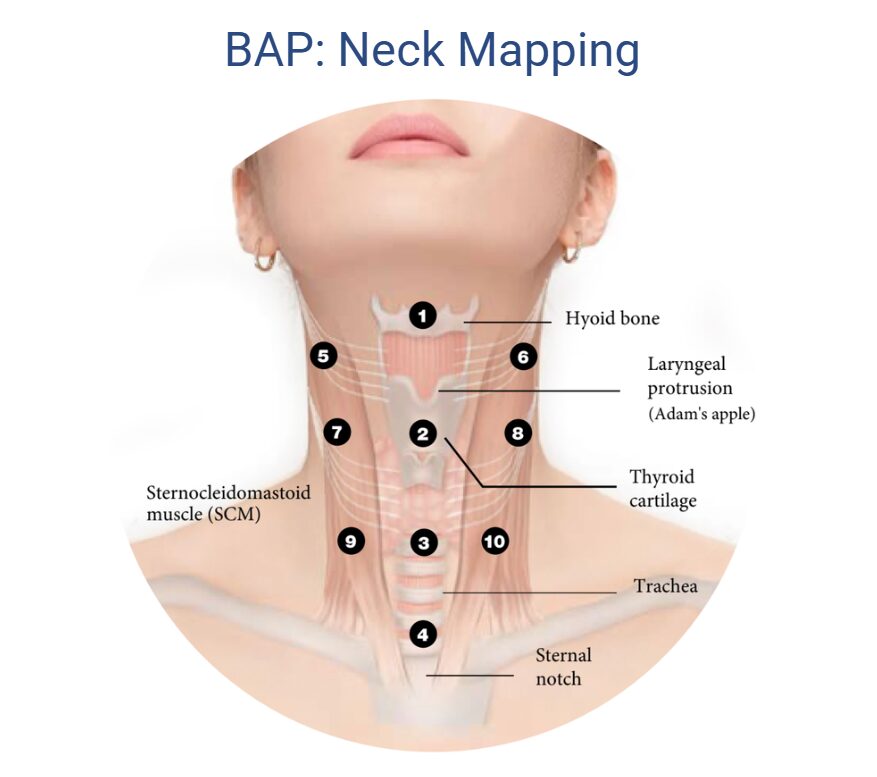
The Bio-Active Point (BAP) technique has become one of the most powerful tools in regenerative aesthetic skincare because of how precisely it targets facial and neck anatomy. The classic BAP mapping uses ten points on the face (five per side) or ten points across the neck. These points are not randomly chosen. They were engineered around areas where lymphatic flow is efficient, vascularity is lower, and the superficial subdermal tissue is loose enough to allow predictable diffusion across the lower face or front of the neck.
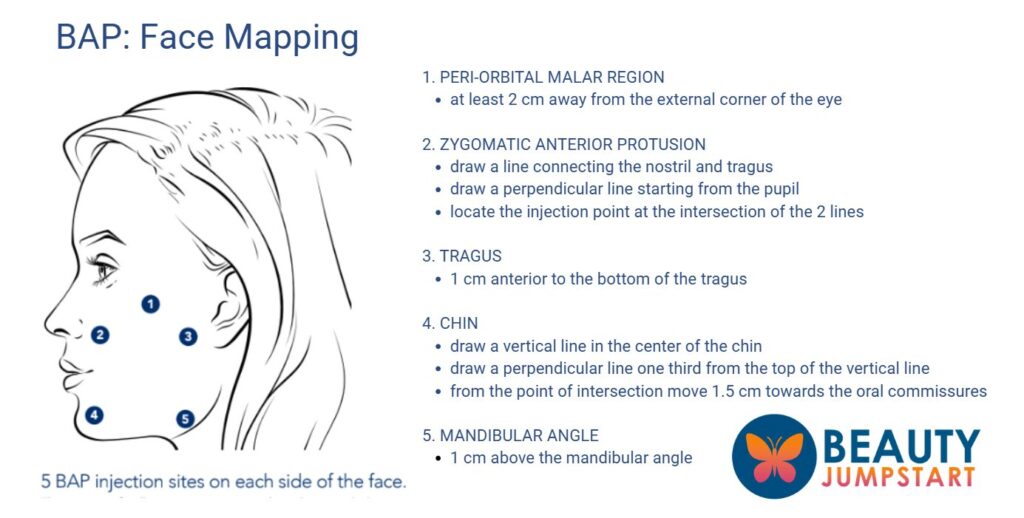
Note: Each BAP point must be adapted to the individual morphology of the person
When a small, cohesive depot of product is placed at each point, the material spreads outward several centimeters in a smooth, sheet-like pattern. This allows the treatment to reach the regions most prone to laxity, dehydration, and structural decline, without requiring dozens of injections. Instead of creating isolated “micro-drops” the way mesotherapy does, BAP works through controlled, broad, subdermal dispersion. The result is widespread hydration, a strengthening effect on the extracellular matrix, and a subtle yet noticeable tightening and rejuvenating response.
But this only works if the right type of product is placed in the right plane. Not everything safe for mesotherapy is appropriate for BAP, because these two techniques operate in very different anatomical environments. Understanding that difference is what keeps BAP safe, predictable, and effective.
Why the BAP Plane Requires Specific Product Behavior
BAP injections are placed into the superficial subdermis – the loose connective tissue directly beneath the dermis. This layer is mobile, spacious, and capable of spreading material widely. In this plane, a product must have enough viscosity and cohesiveness to stay together while still being fluid enough to diffuse gradually.
If it is too thin, it will migrate quickly and unpredictably.
If it is too thick, it will not spread well and may create lumps.
Mesotherapy products are placed in the dermis, which is dense, structured, and designed to keep tiny droplets localized. Those formulas are often intentionally watery because they are meant to sit exactly where they are placed. When those same thin liquids are injected into the BAP plane, they disperse too fast, dissipate unevenly, or become ineffective.
The success of BAP depends entirely on the formulation’s behavior in the subdermis, not simply the ingredient list.
What Can Be BAPed
Hybrid HA biostimulators
These were engineered specifically for BAP. Multi-weight HA products like Profhilo and Lapiena Ninety-Hilo use thermally stabilized, non-filler HA structures that spread evenly through the subdermis, delivering deep hydration, improved elasticity, and collagen-supporting effects. Their viscosity is carefully tuned for controlled diffusion and is the “gold standard” for BAP suitability.
Fun fact: The BAP technique was introduced by Profhilo; most BAP guides are derived or adapted from the official Profhilo product literature.
PN and PDRN with sufficient concentration (typically PN 2% or higher)
The presence of HA is optional. The requirement is natural viscosity and cohesiveness.
Most PN solutions at 2% concentration or higher behave extremely well in the BAP plane. They are thick enough to form a stable depot, yet fluid enough to diffuse broadly. Examples include Oasis PN 2%, Youthfill PN 2.5%, and high-viscosity PDRN products such as Kiara Reju. See my post about PN boosters for more info.
These products distribute in the uniform, sheet-like pattern the BAP mapping is designed for, making them ideal for subdermal delivery.
Lower-concentration PN or thin PDRN serums are excellent for mesotherapy or microneedling but spread too quickly in the BAP plane unless blended with a more cohesive base.
PN/PDRN hybrids with peptides or antioxidants
As long as the final mixture has appropriate viscosity and contains no cosmetic-grade preservatives, these blended formulations can also be BAPed. Their mechanisms of action benefit from slow, sustained exposure, so the right carrier ensures controlled subdermal diffusion.
Select collagen-supporting biostimulators (only those formulated for superficial subdermis)
Some next-generation collagen boosters, such as Lapiena RH-X Collagen are well-formulated for the BAP plane. They contain carefully structured collagen-supporting ingredients that diffuse safely and evenly. See my post about Rh Collagen products for more info.
Deep-plane stimulators like traditional PLLA or PCL do not belong here.
What Cannot Be BAPed
Thin or watery vial-based mesotherapy skin boosters
This includes nearly all of the classic skin booster meso vials: GTM GoldCell PDRN, Revs RMT 140HPn, Curenex, Velatox GF11, Soonsu Ultra Reju, Jeunetique EXO, and similar formulations designed for cosmetic-depth or mesotherapy use.
These products are intentionally watery because they are meant to sit in the dermis, delivered through many shallow meso injections or through microneedling channels. When placed into the BAP plane, they spread too rapidly and unpredictably and cannot create a controlled, slow-release reservoir.
There is no problem with these products – they are simply designed for a different plane.
Formulas containing cosmetic preservatives, botanicals, or fragrances
Anything with phenoxyethanol, ethylhexylglycerin, caprylyl glycol, pentylene glycol, polysorbates, essential oils, or plant extracts is cosmetic-grade. Even if some users meso them, they are not suitable for deeper subdermal injections and should never be used for BAP.
Fillers, cohesive gels, or particulate stimulators
Traditional HA fillers, thick gels, and particulate agents like PLLA or CaHA do not diffuse in the superficial subdermis and require either a deeper plane or a different technique (typically cannula work). These are not BAP materials.
Botulinum toxins
Botulinum toxin should never be BAPed. Although some community members dilute toxin for cosmetic-depth microneedling or for very superficial “microtox” mesotherapy, these techniques involve extremely shallow placement – typically 0.25–0.5 mm for MN or 1–2 mm for true dermal micro-injections.
The BAP plane is significantly deeper and far more mobile. Injecting toxin at this depth risks:
- unintended diffusion into facial expression muscles
- asymmetry or drooping
- unpredictable weakening of muscles responsible for facial support
- delayed complications due to spread within loose connective tissue
- effects that last longer and are harder to correct
Even diluted strains like Innotox behave differently in deeper planes, and the widespread subdermal diffusion that makes BAP effective for PN and hybrid HA is a liability when the ingredient is neuromodulatory.
Botulinum toxin belongs in superficial microdroplet techniques only – never in a depot placed into the subdermis.
Why Mesotherapy and BAP Often Get Mixed Up
Both techniques use skin boosters and syringes, but they are fundamentally different delivery systems.
Mesotherapy is a mapping technique: many points, shallow depth, localized action.
BAP is a depot technique: few points, deeper placement, wide dispersion.
A product optimized for one environment will not behave correctly in the other. BAP relies on selecting products that can diffuse predictably through the subdermal plane.
The Simple Rules
- Thin products = mesotherapy or microneedling.
- Viscous products = potential BAP candidates.
- PN 2% or higher = generally BAP-suitable unless preserved.
- Vial-based mesotherapy boosters = not for BAP.
Formulation behavior, not ingredient category, determines suitability.
Tips & Practical Notes
Total product volume
Most BAP treatments use 2.0–2.5 mL total for the face (1.0–1.25 mL per side). This equates to 0.2–0.25 mL per point, which is enough to create a depot without pooling.
If you have 2.5mL of product, you can do 0.2 mL in the 10 points, then use the remaining product to do some meso points on the forehead.
Injection depth
BAP is injected into the superficial subdermis:
- Deep enough to be below the dermis but above the SMAS and facial muscles.
- This is typically around 2.0–3.0 mm depth depending on skin thickness and the area treated.
- A 30G or 32G needle with a 4mm length is typical.
A helpful mental model:
- cosmetic microneedling targets epidermis/upper dermis (0.25–0.5 mm)
- mesotherapy hits dermis (1–2 mm)
BAP sits just beyond that, in the subcutaneous connective layer.
When skin is loose or mobile, pinch the fold
On areas like the neck, jawline, or lower cheek, it is appropriate to:
- gently pinch a small vertical fold of skin
- insert into the lifted fold
- deliver the BAP depot into the superficial subdermis
This helps avoid deeper planes and improves accuracy.
You should see a temporary “bleb”
A correct BAP injection produces a visible, rounded bleb that flattens over minutes to hours.
- If no bleb appears, the injection was likely too deep.
- If the bleb spreads instantly, the product was too thin.
Massage is not required
Because BAP relies on controlled diffusion through the loose connective tissue, manual massage is generally unnecessary and sometimes counter-productive. Let the product spread on its own.
Bruising risk varies point by point
The peri-oral and mandibular points bruise more easily in vascular people; zygomatic and tragus points tend to be the least reactive.
A slight firmness or “grid-like” feel under the skin is normal
This is the depot dispersing and is typical for the first several days.
Avoid stimulating treatments immediately afterward
Because BAP relies on slow, controlled diffusion, avoid microcurrent, microderm, RF, intense massage, or deep lymphatic drainage for 24–48 hours, unless the product literature states otherwise.
You can follow BAP with cosmetic microneedling — but only immediately afterward
If you want to combine BAP with cosmetic-depth microneedling (0.25–0.5 mm), the microneedling must be done right after the BAP injections, during the same session. This allows the product to settle into the superficial subdermis before the skin begins its inflammatory cascade.
Doing cosmetic microneedling later that day or the next day is not recommended, because:
- the subdermal depots are still stabilizing
- mechanical stimulation can shift the diffusion pattern
- lymphatic flow increases after needling and may accelerate clearance
- you risk extra bruising or disrupting the controlled spread that makes BAP effective
Immediate pairing = fine.
Delayed pairing = unpredictable.
This mirrors what many Korean injectors do: BAP > light cosmetic MN > recovery serums all in a single appointment.
Different Products Use Different BAP-style Maps
Most DIYers use the standard 10-point BAP pattern, shown above, but not all injectables are designed to follow the same map. Watery boosters diffuse easily and work well with the classic layout, while heavier bio-stimulators such as recombinant collagen often use more distributed patterns for even integration. For example, the Karisma Rh Collagen technique uses a 15-point map with smaller blebs, which would be useful to follow if you are using Lapiena RH-X Collagen. There is also the Inblanc method, with several differences from BAP, but similar strategies. It’s helpful to know these variations exist so you can match the method to the material.
Today’s skin boosters offer powerful regeneration tools. The key is placing each product in the anatomical plane where it performs as intended. BAP works beautifully when the product has the right viscosity and structural behavior. Mesotherapy works beautifully when the product is thin and designed for dermal delivery. Matching the technique to the formulation is what keeps treatments safe, elegant, and effective.