
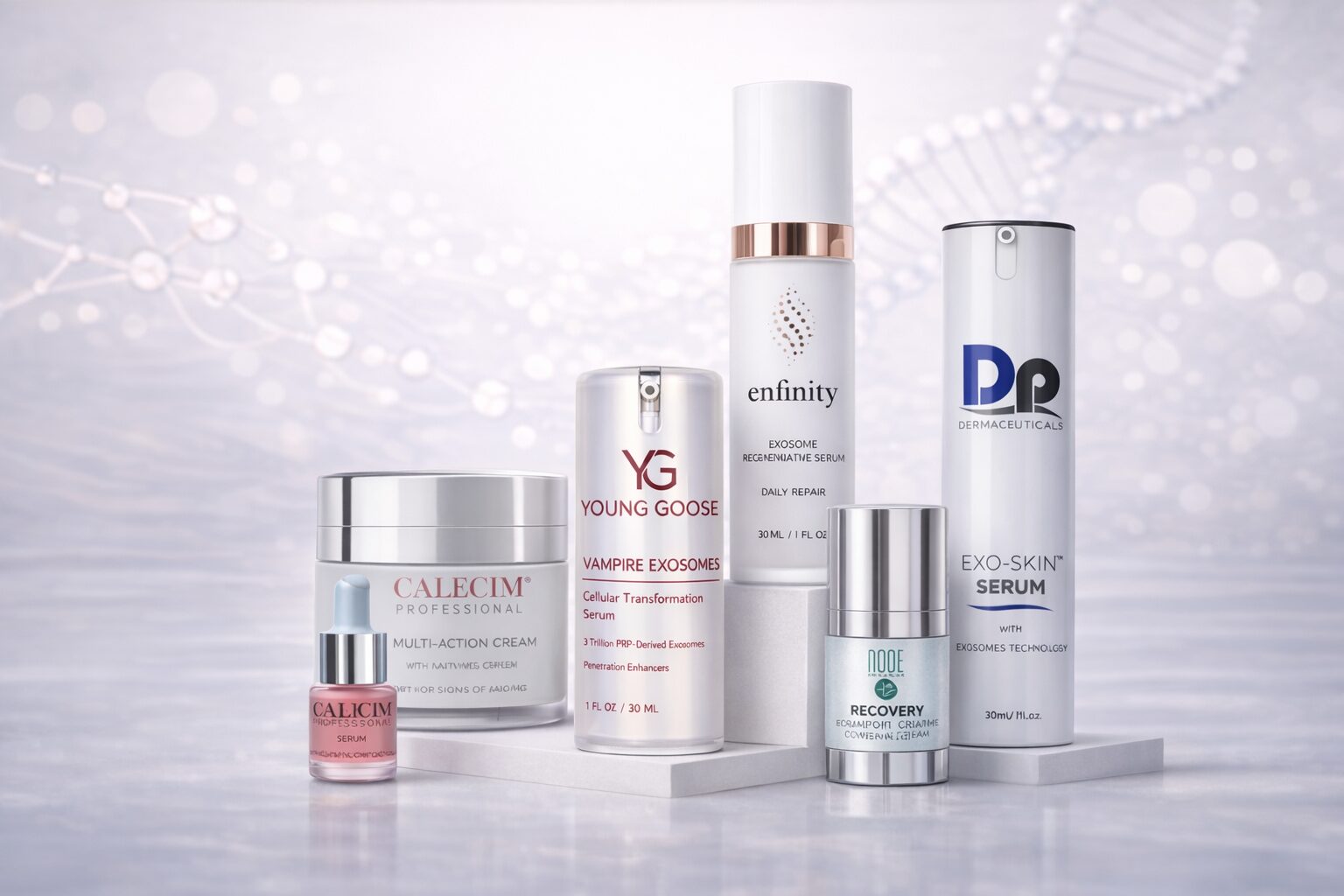
My exclusive research breaks down the new generation of exosome and stem-cell skincare to show you what’s real science, what’s marketing gloss, and where your money actually makes a difference.
If this Ultimate Guide is too long, you can flip to the Quick Guide version here.
Most skincare only works on the surface – hydrating, exfoliating, or protecting. Exosome and growth-factor serums go deeper, targeting how your skin cells actually communicate and repair themselves. These formulas don’t just smooth lines or add glow, they aim to reset the way skin behaves by delivering the same types of messengers your body naturally uses to heal and renew. For anyone who’s already mastered cleansers, retinoids, and sunscreen, regenerative skincare is the next frontier – a way to maintain firmness, texture, and clarity by improving the skin’s own performance over time.
The chart below organizes today’s most advanced regenerative skincare formulas into four tiers, from biologically sourced exosomes to fully engineered biomimetic systems. Its purpose is to help you separate true cellular-communication technologies from marketing noise.
Consumers deserve clarity in a space crowded with vague “stem-cell” language and exaggerated exosome counts. Understanding where a product’s technology comes from, what kind of biological signal it carries, and how stable it is allows smarter purchasing decisions and more realistic expectations of results.
We Are Focusing on Human Biology
Every cell in your skin communicates using microscopic messengers called exosomes – tiny lipid vesicles that carry proteins, peptides, and fragments of genetic code (microRNAs) to neighboring cells. These signals tell cells to repair, regenerate, and behave younger.
Products derived from human or mammalian sources can, in theory, speak the same “language” as your own skin, producing real biological effects that topical peptides or botanicals can’t achieve.
That’s why this analysis excludes:
- Plant-based exosomes or “phyto-exosomes,” which may provide antioxidant support but don’t transmit human-compatible repair signals. Read More: What do Plant Exosomes Actually Do?
Example: Medicube Zero Exosome Shot - Peptide-only “growth factor” serums, which imitate parts of the process but lack cellular communication cargo.
Example: Allies of Skin Multi-Peptides & GF Advanced Lifting Serum
Here, we focus on products that either contain natural human (or mammalian) exosomes or mimic them using engineered nanovesicle systems.
Product Tiers
Tier 1 = Exosome-Based (Highest Regenerative Potency); latest generation technologies
Tier 2 = Next-Gen Stem Cell Conditioned Media (Strong Biological Signaling)
Tier 3 = Legacy Growth Factor Formulas (Fibroblast / Platelet Lysate)
Tier 4 = Synthetic / Biomimetic Systems (Emerging Tech)
How Products Are Ranked Within Each Tier
Each product within a tier is ranked using four key criteria:
- Transparency of Source & Science – How clearly does the brand disclose the biological origin (human, mammal, synthetic) and provide supporting data?
- Evidence of Bioactivity – Strength of peer-reviewed studies, biopsy or imaging data, or credible user-reported outcomes.
- Formulation Integrity – Whether the supporting formula preserves exosome or growth-factor stability (no destructive ingredients, proper pH, and packaging).
- Real-World Consistency – Observable results over time, as reflected by independent practitioner use, experienced consumers, or long-term community feedback.
No brand is “sponsored,” and rankings do not reflect marketing budgets, dermatology legacy, or popularity.
Due to the lack of publicly available verification and the fact that most brands do not release supporting laboratory or clinical data, this guide must rely on a combination of disclosed ingredient sources, marketing claims, and consumer reviews. While efforts are made to prioritize transparency and scientific rigor, in many cases these are currently the best available criteria for evaluating regenerative skincare products.
Data Table
Open the full Google Sheet here: https://docs.google.com/spreadsheets/d/1femT85QaN5jHlMla_6Oo3tbtjYwjDKWf9pWvTtNJgPM/edit?usp=sharing
If you view here, be sure to scroll right and scroll down in the table itself so you don’t miss anything.
Understanding the Source Terms
Many regenerative skincare products use scientific shorthand for where their exosomes or growth factors come from. Here’s what those terms actually mean:
- MSC (Mesenchymal Stem Cells): Multipotent stem cells that can differentiate into many tissues – skin, muscle, bone, fat. Most modern regenerative serums use human MSCs derived from umbilical cord or adipose tissue.
- Umbilical: Refers to exosomes or conditioned media derived from umbilical cord stem cells, prized for their purity and strong growth, repair, and immune-modulating signals. Considered one of the most potent and “youthful” sources.
- Adipose: Derived from fat tissue, often through adult stem cell culture. Rich in regenerative proteins but sometimes less potent than umbilical due to cellular age and variability.
- Bone Marrow: Another adult stem cell source with strong immune and wound-healing activity. Less common in cosmetics due to complexity and regulation.
- Platelet: Refers to platelet-derived growth factors or lysates (like PRP) rather than stem cells; supports healing and inflammation control but lacks exosome-level signaling.
- Fibroblast: Skin cells responsible for collagen production; early “growth factor” serums used fibroblast-conditioned media, which mainly supports surface repair and elasticity.
- Mammal: Covers non-human sources such as red deer umbilical or bovine placenta – used legally in some regions where human materials are restricted, with moderate bio-compatibility.
- Conditioned Media: The nutrient-rich fluid collected after stem cells are cultured; it contains their secreted growth factors, peptides, and cytokines but not necessarily exosomes unless specifically isolated.
Knowing the origin is only part of the story—how these biologic materials are stabilized and delivered is just as important.
Exosome Serums Don’t Need Cold-Chain Storage
Despite the marketing language you’ll often see, exosomes in skincare are not “alive.” They are tiny, non-living lipid vesicles — natural delivery packets that once came from living cells but do not reproduce or metabolize on their own. What matters is whether they remain structurally intact and biologically active after isolation and formulation.
You may have heard that exosome skincare “can’t work” without cold-chain handling. This claim only applies to fresh, injectable biologics, not to the stabilized exosome systems used in modern cosmetic serums. Every Tier 1 product on this chart – such as Elevai, Calecim, Young Goose Vampire Exosomes, DP Derm EXO-SKIN, and Exoceuticals – uses lipid-encapsulated or lyophilized exosomes specifically engineered for room-temperature stability. These vesicles are no longer “live cells”, they’re biologically active delivery packets whose structure is preserved through drying, encapsulation, or emulsion technology.
In these formulas, smart stabilization replaces refrigeration. Each serum is designed so the exosomes stay protected and active at room temperature, surrounded by lipids, antioxidants, and a pH-balanced base that keeps them stable until they touch your skin. Because exosomes are microscopic lipid bubbles – thousands of times smaller than a skin cell – they can naturally blend into your skin’s surface layers and travel down through tiny openings and moisture channels. Once they reach living cells, they “dock” with them and release their cargo of repair signals, helping skin renew itself from within with no needles or refrigeration required.
Why You Don’t See Korean or European Products Here
You may notice that popular Korean and European skincare brands are absent from this chart. Most countries, including the EU, UK, Canada, Japan, China, and Australia, currently ban the use of human-derived exosomes or stem-cell materials in cosmetic products.
Even though South Korea is home to many of the world’s top exosome research labs, nearly all of its consumer skincare lines rely on plant-based or synthetic (“phyto”) exosomes, which are not biologically compatible with human skin in the same way. By contrast, the United States and South Korea (for export-only formulations) are among the very few markets where human- or mammal-derived exosomes can legally be developed for topical or post-procedure use. Some medical clinics in restricted markets still use them off-label.
This is why the products compared here come almost exclusively from U.S.-based biotech brands that operate within cosmetic regulations but still use human cell-conditioned or umbilical-derived exosome technology.
Exosome Counts Don’t Tell the Whole Story
You’ll often see claims like “one trillion exosomes per bottle.” These figures sound impressive, but there’s no standardized testing method to verify exosome number, integrity, or biological activity once incorporated into a serum or cream. A “trillion” exosomes in one formula might equal “ten billion” in another – depending on how they’re counted and stored.
- Different counting methods – Some brands use nanoparticle tracking (NTA), others estimate via protein concentration or microscopy. Results can differ by orders of magnitude.
- Not all particles are active exosomes – A “trillion” might include microvesicles, apoptotic bodies, or broken membrane fragments.
- Purity and preservation matter more – High-function, intact exosomes with verified markers (CD63/CD81/CD9) and sterility testing will always outperform a higher “raw count.”
- Lack of standardization – There’s no global cosmetic standard for how to quantify exosomes per mL or per bottle. It’s not say they are not being counted, but by which method?
For now, consumers should weigh transparency and sourcing over raw numbers. A lower-count product with independently verified human-derived exosomes or third-party stability testing is more credible than a high-count product without supporting data.
Looking To The Future
Human-based regenerative skincare represents one of the most exciting- and most misunderstood – frontiers in aesthetics. The science behind exosomes, growth factors, and biomimetic vesicles is still evolving, but the direction is clear: we are moving from surface correction toward cellular repair. For consumers and practitioners alike, understanding where each product falls in the technological hierarchy helps set realistic expectations.
Tier 1 biologic exosomes remain the gold standard for direct cellular signaling, while Tier 4 synthetic biosomes point to a future where lab-engineered systems may outperform nature itself in purity, consistency, and scalability. The goal of this chart is not to crown a “best” product but to show how technology, transparency, and bioactivity interact.
As the field matures and standardized testing emerges, these rankings will evolve to reflect new data and independent validation.
Further Reading
Are Exosomes Dangerous? What About mRNA?
What Makes Vampire Exosomes Special and Why It Matters
External Links
https://www.pharmasalmanac.com/articles/five-exosome-biotechs-to-watch-july-2025
https://www.marieclaire.com/beauty/skincare/exosomes-for-skin
https://www.cellgs.com/blog/are-exosomes-effective-in-cosmetics.html
https://www.theaestheticguide.com/cosmeceuticals/biomimetic-exosomes-for-stability-in-skincare
https://pmc.ncbi.nlm.nih.gov/articles/PMC12395928
This article reflects independent analysis and interpretation based on publicly available information and scientific literature. It is not affiliated with or endorsed by any of the brands or products mentioned.