
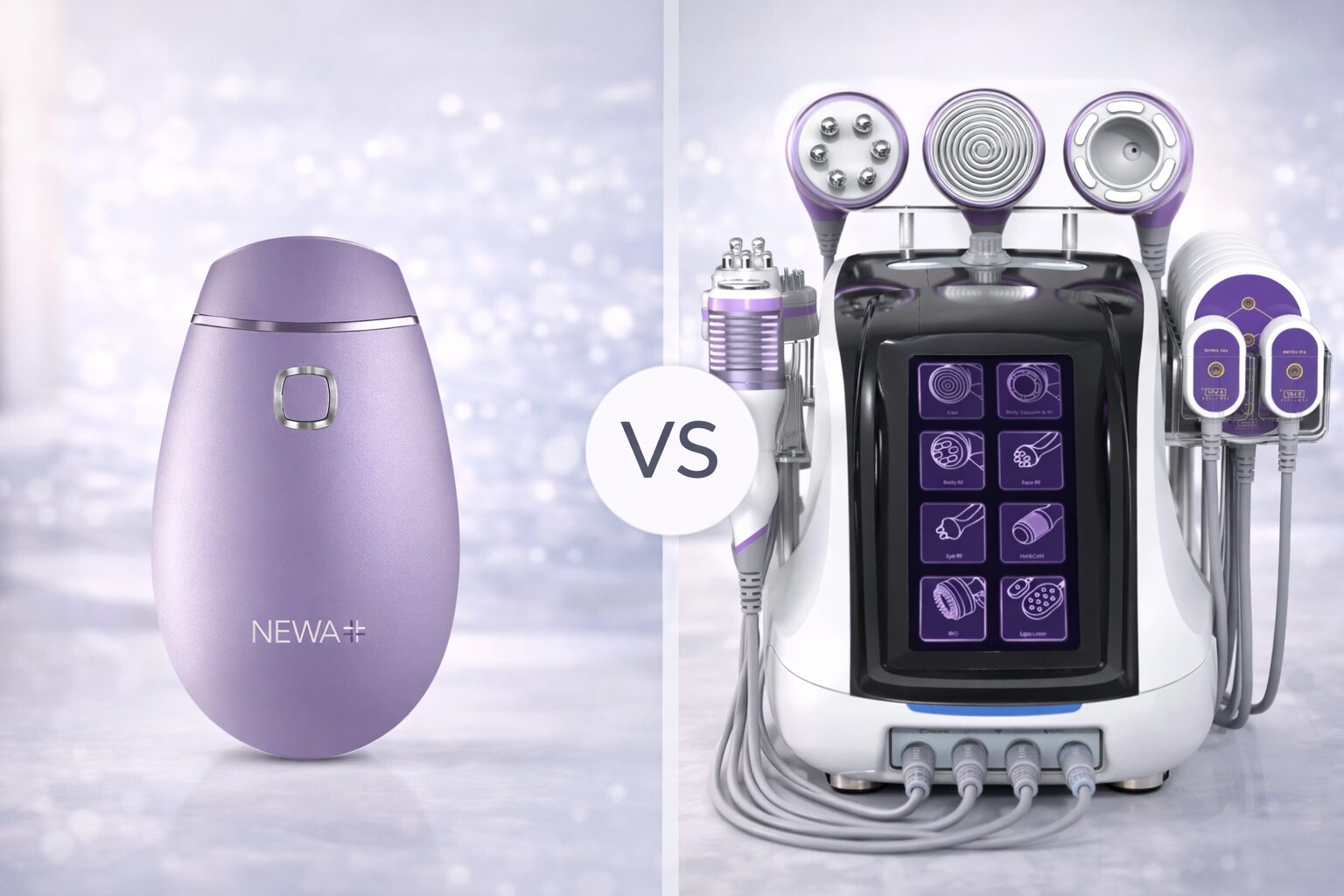
If you’ve been shopping for a Radio Frequency (RF) beauty device lately, you’ve probably noticed something confusing: Some devices promise to give you a “snatched” jawline and plump skin, while others promise to “melt fat” and slim your thighs.
Wait… can one technology really do both?
The answer is yes, but how it’s used makes all the difference. Using the wrong RF protocol in the wrong place is the fastest way to accidentally “age” your face by losing the precious fat that keeps you looking youthful. Let’s break down the science so you can choose the right tool for the job.
RF for Skin Tightening: The “Volume Builder”
When we use RF for skin tightening, our goal is Neocollagenesis (the birth of new collagen) and the thickening of the dermal layer.
- The Target: The Dermis (the middle layer of your skin).
- The Science: These devices use a specific frequency (usually higher) and a controlled “thermal budget” to heat the skin to about 40°C – 42°C. This heat “tricks” your skin into thinking it’s been injured, so it rushes to produce new collagen and elastin.
- The Result: Thicker, firmer, bouncier skin and a reduction in fine lines.
- The Danger: If the heat goes too deep, it hits the fat layer and can cause it to “melt.” On the face, we want that fat! It’s what gives us high cheekbones and a smooth contour, while losing it leads to a hollowed, “gaunt” look.
RF for Body Contouring: The “Fat Shrinker”
On the body, we often have the opposite goal: we want to slim down stubborn pockets of fat or smooth out cellulite.
- The Target: Subcutaneous Fat (the “pinchable” layer below the skin).
- The Science: Body-focused devices often use higher power (wattage) and wider electrode spacing to drive heat much deeper into the tissue. When fat cells hit a sustained high temperature, they undergo apoptosis, where the fat cell essentially “checks out” and is eventually flushed away by your lymphatic system.
- The Result: A reduction in circumference and a smoother body silhouette.
- The Danger: Using this “fat-melting” logic on your face can lead to Lipoatrophy (hollowed cheeks and sunken eyes).
Choosing Your Equipment: The Guide
Category A: Dedicated Skin Tightening
These are handheld devices engineered to stay in the collagen lane and avoid deep-tissue fat pads.
- NEWA: A gold standard for safety; its 3DEEP technology keeps energy focused strictly in the dermis.
- CurrentBody Skin RF: Features sensors that check skin temperature 100 times per second to ensure you don’t exceed 43°C (109°F).
- Medicube Age-R Ultra Tune 40.68: Operates at a frequency of 40.68 MHz, which is significantly higher than most home units (which typically operate around 1 MHz). This high frequency allows for “volumizing” heat that persists in the tissue long after the treatment ends.
- TriPollar STOP Vx 2 or STOP Vx GOLD 2: Known for Multi-RF and Turbo-RF. The Vx 2 models use interchanging radio waves to “comb” through multiple layers of the dermis simultaneously. The “Gold” edition features 24-carat gold-plated electrodes for superior conductivity.
- Jmoon MaxLift (M30): Jmoon is a leader in the Asian beauty-tech market, known for its extra-large electrode heads. This massive surface area allows you to treat the entire face in as little as 90 seconds to 5 minutes. Utilizes “variable frequency” RF and 5D induction microcurrent to reach from the dermis down to the fascia. It features a sophisticated triple-detection system (NTC temperature control, motion detection, and current contact) to ensure high-power safety.
- Amiro (R3 and S2 Series): Offers a 3-in-1 approach, combining RF, microcurrent (EMS), and Red/Yellow LED light therapy.
Category B: Advanced Hybrid Systems
For those who want a professional-level “Swiss Army Knife” for both face and body. Brands like Mychway offer multi-handle stations that physically separate the technologies for safety.
- 9-in-1 Aristorm Systems: These include multiple dedicated, lower-wattage Bipolar handles for the face and high-powered Cavitation + RF handles for the body.
- 3-in-1 Portable Units: These allow you to switch from a 3-polar facial handle (skin tightening) to a 6-pole body handle or 40K ultrasonic cavitation handle (fat destruction) for the body.
Whether you are treating facial fine lines or tightening the ‘envelope’ of the skin on your abdomen, selecting the correct handle configuration is the most important step in your protocol. If you own a multi-handle RF machine, you can identify the “type” by looking at the electrode configuration and power output:
Bipolar Handle (Small):
- Design: Two electrodes spaced very close together.
- Wattage: Typically lower (~30W).
- Biological Goal: Shallow skin tightening. Best for precision areas like the eyes, forehead, and delicate neck tissue.
6-Polar Facial Handle (Medium):
- Design: Multiple electrodes in a medium-sized head.
- Wattage: Mid-range (~50W).
- Biological Goal: Dermal volumizing and lifting. Best for the cheeks, jawline, and tightening the skin on the upper arms.
6-Polar Body Handle (Large):
- Design: Large head with electrodes spaced widely apart.
- Wattage: High (~60W+).
- Biological Goal: Deep fat contouring and slimming. Best for the abdomen, thighs, and glutes.
Body RF Zones
- The Neck: This is a high-reward but high-risk area. Focus your RF on the sides of the neck and the jawline. Avoid the center of the neck (the thyroid gland) and the pulse points (carotid arteries). Use only Bipolar or small Facial RF handles here—never body-contouring or cavitation tools.
- The Abdomen: If your goal is tightening skin after weight loss, use the medium or large RF handles. If you still have localized fat you want to reduce, you can incorporate the Cavitation handle, but always finish with an RF pass to ensure the skin doesn’t become lax as the volume decreases.
- The Arms: To treat “batwings,” use a medium RF handle in circular motions. Avoid direct pressure or high heat in the armpit area, as this can irritate delicate lymph nodes.
Bottom Line
Before you press “start,” ask yourself: “Am I trying to build skin or shrink fat?” If you’re working on your face or neck, stay in the shallow lane. If you’re working on your body, you can go deep—but always respect the “thermal budget” of the area you’re treating.
Consistency is key, but so is accuracy. Your future self (and your cheekbones) will thank you!
Also see this article: RF Microneedling
This article reflects independent analysis and interpretation based on publicly available data, product literature, and scientific research. It is not affiliated with or endorsed by any brand or manufacturer mentioned. All procedural descriptions are for informational context only and do not constitute guidance or endorsement of self-administration.