
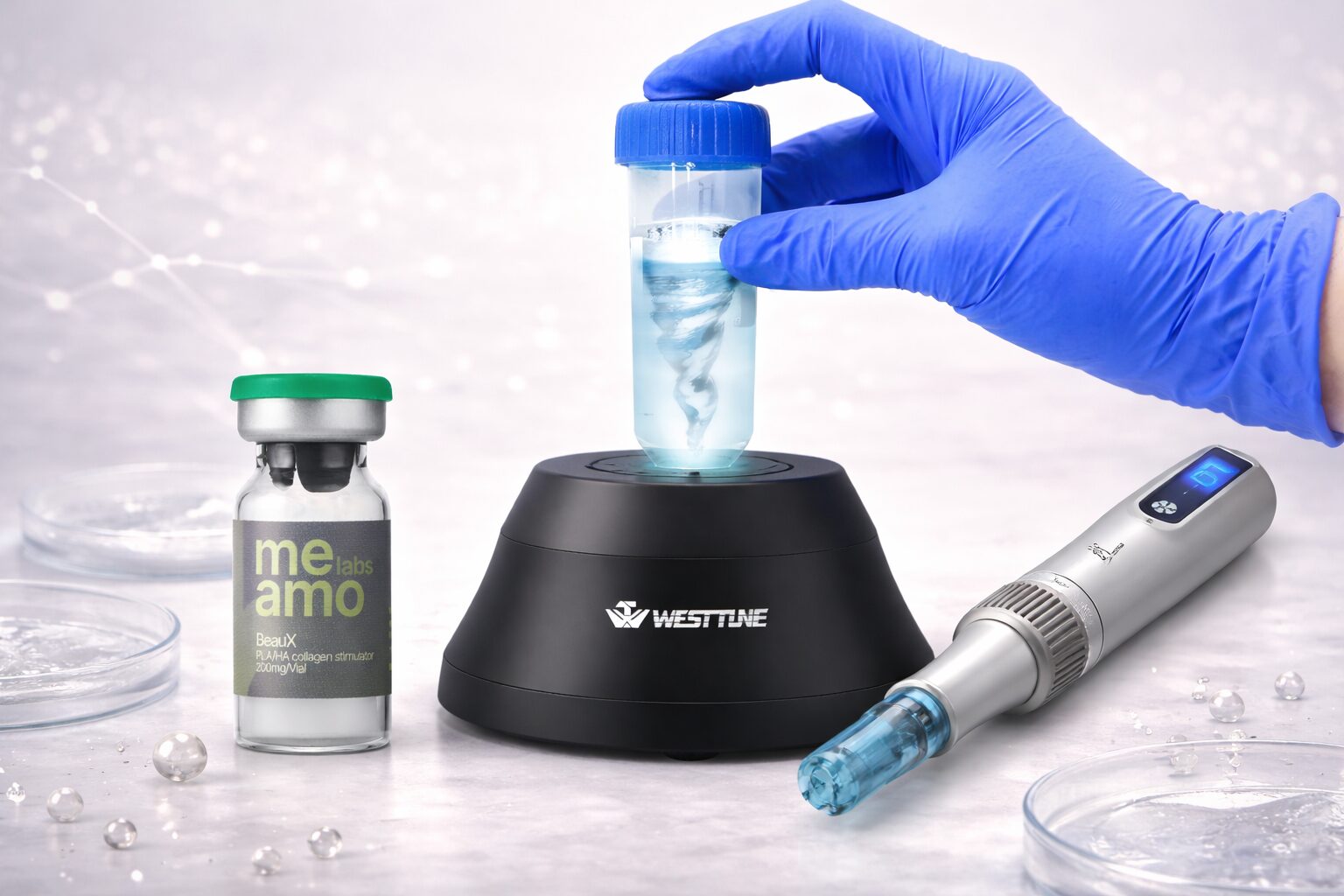
Micro Sculptra: an alternative PDLLA + HA Biostimulatory treatment method
Treatment Type: Medical Microneedling
You may see Micro Sculptra treatments marketed by med spas. You may also see doctors talking about why it isn’t a great idea, and some people in online forums saying it’s a waste of product — this is true! But we are using an adapted recipe that is better suited for this purpose.
The nickname “Micro Sculptra” comes from adapting the original injectable Sculptra (poly-L-lactic acid) concept, a biostimulator known for rebuilding collagen and restoring volume, into a refined, surface-level format delivered by microneedling rather than deep injections or canula.
This treatment uses poly-L-lactic acid (PLLA) or poly-DL-lactic acid (PDLLA) in a diluted suspension applied at medical depth (~0.5–1.25 mm) to evenly disperse microscopic polymer particles throughout the dermis. The result is a gentle activation of fibroblasts, stimulation of collagen I and III synthesis, and long-term dermal remodeling that produces firmer, denser skin without added bulk, lumps, or filler-style volume.
Why It Works
PLLA / PDLLA microspheres act as biodegradable collagen stimulators. When dispersed through the dermis, the immune system responds with controlled fibroplasia rather than granuloma formation, encouraging healthy collagen remodeling instead of inflammation.
Combined with non-crosslinked hyaluronic acid, the blend delivers immediate hydration while providing a temporary scaffold that supports collagenesis for several weeks.
While medical-depth microneedling on its own already triggers new collagen through the body’s natural healing cascade, Micro Sculptra enhances and extends that effect. The embedded PDLLA particles remain in the dermis as a biodegradable matrix, continuously signaling fibroblasts to keep producing collagen and elastin long after the usual healing period. This creates firmer, thicker, better-supported skin that lasts for months rather than weeks.
Choosing a Biostimulant Base
BeauX from Meamo Labs combines 150 mg of PDLLA with 50 mg of non-crosslinked hyaluronic acid in one vial, making it an ideal candidate for Micro Sculptra delivery. Unlike traditional Sculptra, which contains larger PLLA particles intended for subdermal injection, BeauX features nano-sized PDLLA spheres that are small enough to pass through microneedling channels and disperse evenly throughout the dermis. This size is incredibly important to the process and is a marked difference from the original Micro Sculptra.
Each sphere is also precisely uniform in size and shape, allowing it to travel smoothly through microchannels without catching on the walls or causing micro-tears. This uniformity helps achieve consistent collagen stimulation across the treated area and reduces the risk of uneven texture or nodularity. Note that the Sculptra brand product has irregular spheres, which is fine for injection but not so much for travelling through a channel in your skin.
The built-in hyaluronic acid component provides both hydration and lubrication during needling and serves as a carrier matrix that distributes the PDLLA microspheres evenly as the skin heals.
Another option from Meamo, BeauY, contains PLLA microsphere technology and can also pass through microneedling channels effectively. However, BeauY lacks hyaluronic acid, so it does not offer the same glide or immediate hydration as BeauX. For most users, BeauX provides a more balanced texture and easier handling during medical-depth microneedling.
Comparable alternatives such as Fillunar L200 or Revolax LLA share similar PDLLA/HA ratios and behavior, but BeauX remains particularly well-suited for microneedling due to its smaller, smoother particle morphology. Plus, Meamo regularly offers BeauX at a discounted price putting this treatment under $100.
Ultimately, at this depth and placement, the brand is less critical than proper dilution and even dispersion.
Recommended Boosters and Add-Ins
Do you want to amp it up? You can replace some of the saline with a booster instead. Because PDLLA already supplies biostimulation, supporting serums should emphasize hydration and soothing rather than regeneration overload.
Compatible Add-Ins
- Hyaron – adds fluidity and slip (but BeauX already has HA)
- Revitalex PDRN – gentle healing and anti-inflammatory support
- Curenex – multi benefit skin booster
- Oasis PN – light PN complement
Avoid Add-Ins
- Highly bioactive exosome serums (Dermagen EXOSIA, Jeunetique EXO)
- Viscous peptide or placenta creams intended for post-treatment use
Mixing Ratio
BeauX (150 mg PDLLA + 50 mg HA) requires thorough vortex mixing to ensure even suspension of the polymer microspheres. Without full agitation, the particles can clump and create uneven texture or injection resistance.
A vortex mixer is strongly recommended. An inexpensive lab-style model works perfectly (compact desktop versions are widely available for ~$25 USD on Amazon). Once the diluent is added, the vial should be mixed on a vortexer for at least 30 minutes at 3000rpm, occasionally pausing to check for any sediment at the bottom. Continue until the liquid appears uniformly milky with no visible particles.
Standard Dilution
- Option 1 – Classic: 6 mL sterile saline or bacteriostatic saline water
→ yields a light, milky serum texture suitable for microneedling at 0.5 – 1.0 mm. - Option 2 – Enhanced: replace some or all of the saline with a thin, watery skin booster that tolerates mechanical agitation.
Good candidates include:
• Curenex PDRN – stable, clear, and thin enough for vortexing.
• Soonsu Ultra Reju – similarly low viscosity and peptide-balanced.
• Hyaron (HA) – very fluid and vortex-safe if gentle hydration is the goal.
All of these can be combined with saline to reach 6 mL total.
Avoid thick, viscous boosters (Velatox GF11, Kiara Reju, EXOSIA, etc.) since they can shear or foam during vortexing.
Do not add exosomes: the residual PDLLA suspension has a slightly acidic pH and still contains suspended polymer particles that can destabilize exosome membranes and surface proteins. Essentially, they’d burst on contact and lose their regenerative signaling.
On the other hand, PDRN and PN absolutely can handle vortex mixing and mechanical blending. They’re nucleic acid fragments (short DNA or RNA polymers), not living biological vesicles like exosomes. Their structure is extremely stable in saline and can tolerate both mechanical agitation and moderate temperature changes.
Preparation Steps
- Draw 5 mL of chosen diluent (saline or booster + saline) into a sterile syringe.
- Slowly inject into the BeauX vial through the rubber stopper.
- Cap securely and mount the vial on a vortex mixer for ≥ 30 minutes until fully homogenized.
- Use immediately; do not store, as polymer particles will settle over time.
The finished blend should appear milky, smooth, and fluid, with no visible clumps or sediment. When swirled, it should move like a light serum or thin lotion, spreading easily without sticking or forming bubbles. If the mixture feels thick or uneven, continue vortexing until it flows uniformly. In professional terms, it should have the same flow as a mesotherapy solution — easy to spread, not paste-like.
Application Guidelines
Depth: ~ 0.5 mm (forehead / under-eyes) to 1.0 – 1.25 mm (cheeks, neck, chest)
Device: Medical-depth microneedling device (e.g., Dr Pen with a 12 or 16-pin cartridge) on low speed
Pattern: Uniform cross-hatch or stamping pattern for even distribution
Why Depth Matters
Micro Sculptra is performed at medical depth, within the upper-to-mid dermis; deep enough for PDLLA particles to anchor where collagen fibers form, but still above the subcutaneous fat layer. Placement that is too deep (subdermal or fat-pad level) can lead to nodules or uneven volume; placement that is too shallow may leave polymer residue on the surface without effective biostimulation.
The goal is a true dermal deposition: deep enough to stimulate fibroblasts, yet superficial enough to ensure smooth integration and even remodeling.
Frequency
A series of three sessions spaced four weeks apart is commonly used for noticeable dermal thickening.
Maintenance once every 3-6 months helps sustain collagen turnover.
Results develop gradually over 4-8 weeks as new fibers form.
Further Reading
- Reddit r/DIYaesthetics: I microneedled w/ Beaux PDLLA + HA
- What is Microneedling with Sculptra? – Tempo Wellness Nashville
- The Benefits of Combining Microneedling with Sculptra (A Powerful Duo for Skin Rejuvenation) – Aisling MedSpa
- Microneedling with PRP, Exosomes or Sculptra – Skin Envy Austin
- Poly-L-Lactic Acid as a Biostimulatory Filler – Dermatologic Surgery Review (2021)
- Histologic Changes After Superficial PLLA Injection – Aesthetic Plastic Surgery (2019)
- Safety and Efficacy of PDLLA Microspheres in Facial Rejuvenation – Journal of Cosmetic Dermatology (2022)
- Collagen Stimulation Mechanism of PLLA and PDLLA Fillers – Plastic and Reconstructive Surgery Global Open (2023)
This formulation is shared for educational / research purposes. Not intended for diagnosis, treatment, or substitution for professional medical care. Always follow sterile technique and local regulations.