
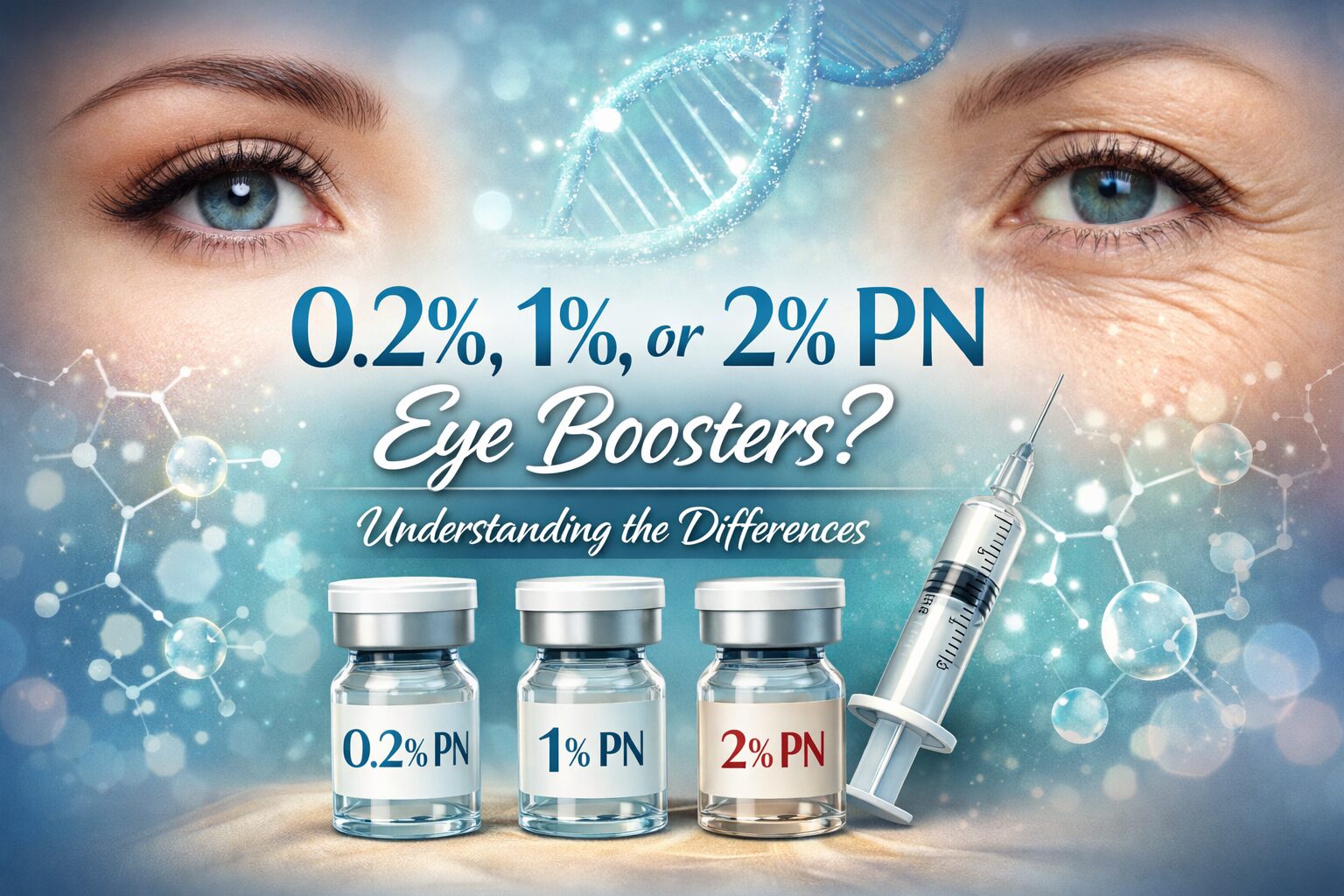
Polynucleotide (PN) eye boosters have become popular for improving the delicate under-eye area. These treatments are designed to stimulate tissue repair, support collagen production, and improve the overall quality of thin, aging skin.
When comparing PN eye boosters you need to review the amount of the active ingredient: most PN eye boosters fall into two strength categories.
The most common formulations are:
- 0.2% PN (2 mg/mL)
- 1% PN (10 mg/mL)
More recently, some practitioners and experienced DIY users are even using 2% PN formulations – the same strength often used for facial treatments.
At first glance, these differences can seem confusing. Why would eye boosters use such a low concentration, and why are some people now using stronger formulations?
The answer lies in the history of PN treatments, how these products behave in the skin, and how treatment protocols have evolved over time.
How Rejuran Established the 0.2% Standard
Much of the 0.2% PN convention traces back to the early Rejuran PN protocols.
Rejuran was one of the first widely recognized PN treatments used in aesthetic medicine. The original formulation contained 0.2% PN (2 mg/mL) and was designed specifically to prioritize:
- minimal swelling
- predictable diffusion
- reduced risk of visible papules
The skin under the eyes is extremely thin – often only 0.3–0.5 mm thick – so practitioners wanted a solution that would spread easily through the superficial dermis without leaving noticeable bumps.
Early treatment protocols also relied on multiple sessions, typically spaced a few weeks apart. Rather than delivering a large PN dose in one treatment, the goal was to stimulate regeneration gradually over time.
Because Rejuran became highly influential in aesthetic clinics, many manufacturers followed the same template. As a result, 0.2% PN became the default concentration for early PN boosters.
Why Higher-Strength Eye Boosters Appeared
Over time, practitioners noticed something important about PN solutions.
Even at higher concentrations, PN behaves like a very fluid injectable, not a thick gel like hyaluronic acid fillers. The DNA fragments diffuse easily through tissue rather than remaining in place.
This observation led manufacturers to introduce stronger PN formulations, including eye boosters around 1% PN (10 mg/mL).
Interestingly, the Rejuran line itself eventually reflected this shift. Rejuran I, a later formulation, contains 1% PN, showing how the industry gradually became more comfortable using higher PN concentrations around the eyes.
Today, both strengths coexist, reflecting different treatment philosophies.
Understanding PN Dose
The key difference between PN concentrations is not the size of the blebs – that is determined by the volume injected. Instead, concentration determines how much PN is delivered to the tissue during each treatment. If the same 1 mL total volume is injected around both eyes, the PN delivered would be:
0.2% PN → 2 mg PN
1% PN → 10 mg PN
2% PN → 20 mg PN
The injection points and papules look the same, the difference is simply how much regenerative signal reaches the tissue.
What Clinical Studies Suggest About PN Dosing
Clinical studies of PN treatments provide useful context. In trials evaluating PN for wrinkles and skin regeneration (see Further Reading below), patients typically received multiple treatments spaced two to four weeks apart, with each delivering roughly 10-20 mg of PN per session. Across a three-session series, that amounts to 30-60 mg of PN total exposure.
By comparison, a typical 0.2% PN eye treatment using 1 mL total around both eyes delivers only 2 mg of PN. Even across a three-session protocol, that totals about 6 mg of PN.
This difference helps explain why many eye booster protocols rely on repeated treatment sessions to gradually accumulate the PN dose.
My Experience With Higher-Strength PN
When I recently performed an eye treatment using 1% PN (Jeunetique Eyes Pro), several injections created large blebs and some ran together under the skin. I am not the most skilled injector, so this can happen easily in the thin under-eye area because the fluid spreads quickly. Despite that, the swelling resolved within about 24 hours.
This illustrates an important point: even stronger PN solutions remain very fluid and typically diffuse rapidly through tissue rather than sitting in place like fillers. In practice, this means higher concentrations often behave cosmetically very similarly while delivering a larger PN dose.
The Emerging 2% DIY Treatment
Within the DIY community, many experienced users now skip eye-specific boosters entirely and simply use 2% PN formulations – commonly used for facial treatments – in the under-eye area as well.
Because PN diffuses easily through tissue, higher concentrations can still settle quickly when injected superficially. The main difference is technique: using very small deposits and careful spacing in the thin under-eye skin. If the skin tolerates the treatment well and papules resolve normally, this approach allows a much larger PN dose to be delivered in a single session rather than spread across multiple lower-strength treatments.
When doing a 2% PN around eyes, be careful which PN product you choose. If it has added HA, particularly a high concentration, it can backfire and cause puffiness as the HA attracts water and swells. I prefer a pure 2% PN product or one with Lido.
In practice, when I am using a plain 2% PN product on my face, I start by putting 5 small blebs under each eye at around 0.3-0.5mm depth – very superficial – then use the rest of the syringe to meso or BAP the rest of my face.
See my article A Cheat Sheet for PN Boosters: Getting Value in Regeneration for more info on 2% PN products.
Does Age Affect Which PN Strength Works Best?
Age and skin condition can also influence which PN concentration makes sense.
Younger skin already has strong fibroblast activity and relatively healthy collagen production. In these cases, lower concentrations like 0.2% PN may be sufficient, particularly for preventative treatments.
As skin ages, however, fibroblast activity declines and collagen loss accelerates. In these situations, stronger PN concentrations such as 1% or 2% may provide a more meaningful regenerative signal.
Ultimately, the best guide is how the skin responds to treatment. If papules resolve normally and the skin tolerates the injections well, higher concentrations can often be used safely with careful technique.
Treatment Schedules: Do You Stop After the Initial Series?
Most PN protocols recommend an initial series of 4-6 treatments spaced two to four weeks apart. This early phase helps stimulate fibroblasts, support extracellular matrix repair, and encourage collagen remodeling.
But an important question remains: do you stop after that? In practice, most people transition to maintenance treatments rather than stopping completely, especially for DIY treatments where we have access to inexpensive products.
PN works by stimulating the skin’s natural repair processes, but aging and collagen breakdown continue over time. As the PN molecules are gradually metabolized, the regenerative signaling they trigger slowly fades. For this reason, I recommend occasional maintenance treatments to help sustain the improvements in skin quality.
Products by Strength
0.2% PN (2 mg/mL)
Eye Boosters
- Dr. Fill Eyes
- Eve Eyes
- Lexyal Diva Eyes
- Puri Eyes
- Puri Eyes Pro (6mg/0.6%)
- Pure Pro
- Re:Prima I
- Reglory Eyes
- Sheer Eyes
- Spider Aqua Eye
- Ultra Eyes
1% PN (10 mg/mL)
Eye Boosters
- Ami Eyes
- Cindella I
- Clair Eyes
- Curenex Eye
- Eyebella
- Eve Eyes Pro+
- Illuma Luna Eyes
- Jeunetique Eyes Pro
- Juve Eyes
- Reglory Eyes Black
- Rejuran I
- Rejuva Eye
SK Tip #1: Some manufacturers market PN eye boosters using percentage-style branding that does not correspond directly to the actual PN concentration. For example, a product may be labeled “6% potency” even though the true PN content is closer to 2 mg/mL (0.2%). When comparing products, it is more useful to look at the actual PN amount per milliliter (mg/mL) rather than the marketing percentage. Example: Puri Eyes and Puri Eyes Pro
SK Tip #2: Unless you are truly sensitive or need your blebs to go down very quickly, then the 0.2% products don’t make financial sense. On the surface, they are generally a bit cheaper than the 1-2% PN products. However, they are not 5x-10x cheaper than the 1% or 2% PN products. If you have to buy and perform 5 treatments of a 0.2% product to equal one treatment of 1% product, how are you saving money or time?
SK Tip #3: Within each PN % group, most products are very similar. Some may have additional ingredients, like Spider Aqua Eye or Jeunetique Eyes Pro, but generally most are just PN plus saline water. Therefore, no need to get hung up on which brand to buy. Buy whichever is most convenient to the vendor you are using and at a price that makes sense.
SK Tip #4: On second thought, don’t choose Clair Eyes even if it is 1% PN. It has an acidic pH and many users say it burns terribly and is uncomfortable to use.
The Big Picture
The different PN concentrations ultimately reflect different treatment philosophies rather than strict biological rules.
Lower concentrations like 0.2% PN emphasize safety and gradual improvement through many repeated sessions.
Higher concentrations such as 1% or 2% PN deliver a larger PN dose in each treatment, which may reduce the number of sessions needed to achieve similar cumulative exposure.
Understanding how these concentrations affect dose, treatment frequency, and overall strategy allows knowledgeable users to choose the approach that best fits their goals.
Final Thoughts: SK’s Conspiracy Theory
Why are so many brands still making and selling a lot of 0.2% PN eye boosters when we know we can safely use higher amounts to effect change in fewer treatments and a shorter amount of time? I feel like there are too many 0.2% products on the market for how little change it effects.
My hot take – which is purely a hypothesis – is that it is a two-pronged issue. First, med spas are in the business to sell multiple-treatment packages to customers, and with a weaker, cheaper formula they can get customers to return more often. Plus, customers can fit this eye treatment in on their lunchbreak and still go out to dinner that night without visible blebs. Second, the manufacturers cater to med spas, so they create what their customers want – which arguably gives them a benefit too. They are selling a product that has a much higher margin because the raw active ingredient is the most expensive part – it has 5x less active ingredient so their profit becomes much higher. Plus, most customers are not paying attention to the amount of active ingredient in a PN Eye Booster (in my case, until I started getting curious I did not either).
Therefore, I feel like the DIY community should stick to 1% or higher. Let’s get more value from our products.
Further Reading
Prospective Observational Study of Polynucleotide Injections for Periorbital Rhytides – evaluates longitudinal changes in periorbital appearance and patient‐reported outcomes with 42 participants. Significant improvements in lower eyelid and crow’s feet appraisal scores were observed at all follow‐up time points compared with baseline. The greatest improvements and highest patient satisfaction were observed at 3 months following two treatment sessions. Reported adverse events were minimal.
A Randomized, Participant‐ and Evaluator‐Blinded, Matched‐Pair, Prospective Study Comparing the Safety and Efficacy Between Polycaprolactone and Polynucleotide Fillers in the Correction of Crow’s Feet – compares results between using PCL dermal filler and Rejuran PN on crows feet wrinkles. 218 participants. Both were effective, but after 3 months PCL was considered a “significantly higher improvement rate.” It’s important to note this study was looking at improving crows feet wrinkles to the sides of the eye, not in addressing common eye issues like crepey skin and darkness/discoloration – these symptoms do respond well to PN. Nevertheless, this clinical is interesting to see how they used it, and to note that PN was also effective with crows feet wrinkles, just not to the same effectiveness.
This article reflects independent analysis and interpretation based on publicly available information and scientific literature. It is not affiliated with or endorsed by any of the brands or products mentioned.