
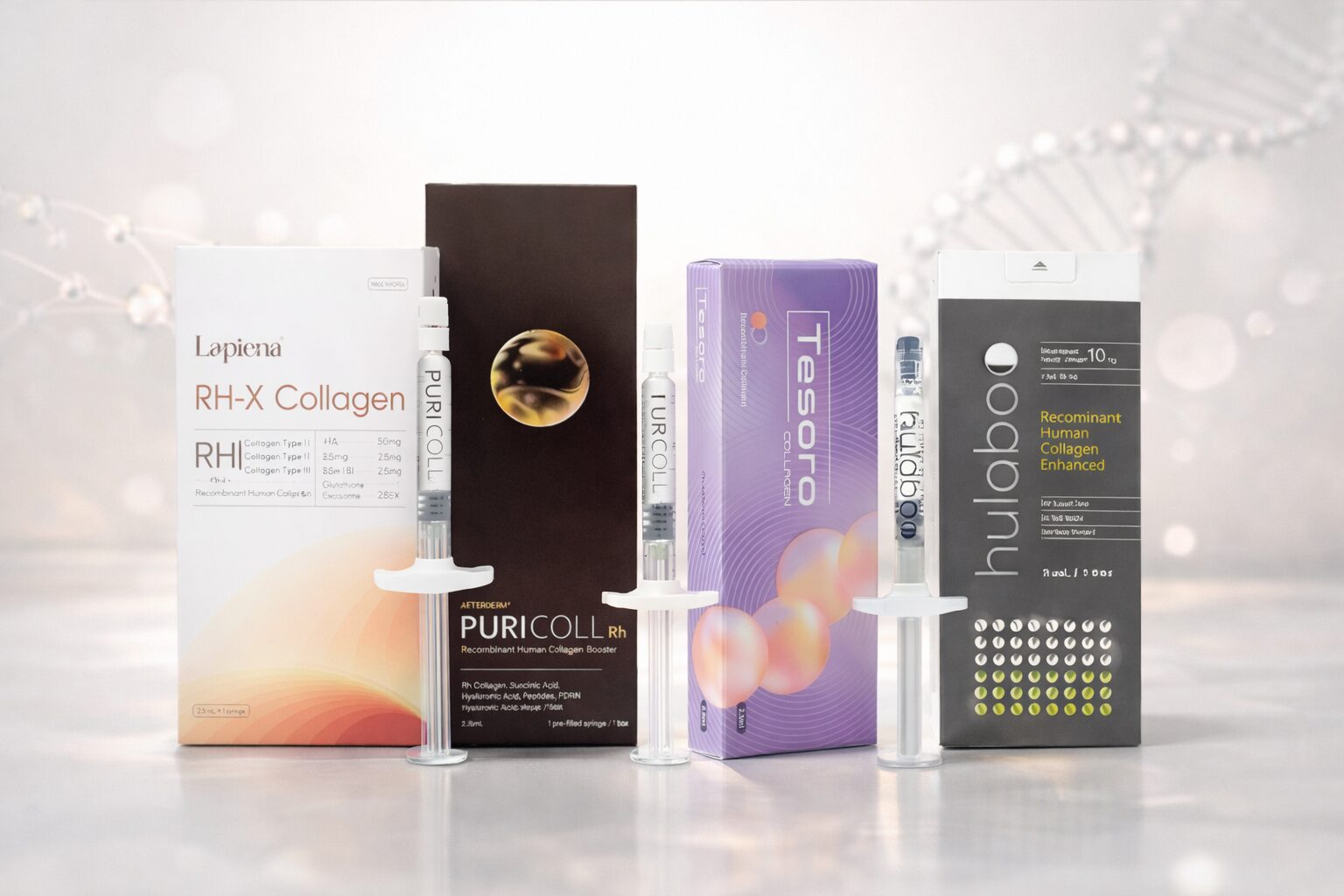
The world of aesthetic medicine is shifting from temporary volume “filling” with HA fillers to long term “biostimulation.” Recombinant human-like collagen (RHLC) injectables are at the forefront of this change, offering lab-engineered, non-animal-derived alternatives that are molecularly nearly identical to the collagen in your own body.
Prior to 2021, animal-derived collagens – specifically bovine (cow) and porcine (pig) – were the leading global industry standards for several decades. The market began a structural shift in June 2021 with the first NMPA-approved recombinant humanized collagen injectable. By 2025, this matured into a profusion of specialized South Korean releases, successfully moving the category from ‘human-like’ functional fragments toward 100% human-identical sequences.
Brand Comparison
I will update this chart as I discover new products or additional information
| Brand | Primary Collagen Type(s) | Key Ingredient Amounts | Unique Features & Synergistic Components | Manufacturer |
|---|---|---|---|---|
| Lapiena RH-X | Recombinant Type I & Type III | 15 mg Total RH Collagen (7.5 mg Type I + 7.5 mg Type III); 50 mg Hyaluronic Acid | Integrates Succinic Acid and plant Exosomes to enhance tissue repair and restore firmness, with Niacinamide, TXA, and Glutathione for texture and brightening. | HJ Corp |
| PuriColl Rh | Recombinant Type I & Type III | 15 mg Total RH Collagen (7.5 mg Type I + 7.5 mg Type III); 50 mg Hyaluronic Acid | Features Succinic Acid to enhance tissue repair and PDRN for healing. Includes multi-peptides to encourage collagen activation and prevent degradation. | Aeterderm/ Wederm |
| Reglory RH Collagen | Recombinant Type I & Type III | 15 mg Total RH Collagen (7.5 mg Type I + 7.5 mg Type III); 50 mg Hyaluronic Acid | Includes Succinic Acid to enhance tissue repair and PN 5mg, which provides a scaffolding effect and longer-lasting structural support. No additional peptides or brighteners. | Medisco/ EVIE KOREA |
| Hulaboo | Recombinant Type I | 10 mg RH Collagen; 50 mg Hyaluronic Acid | Minimalist formula, only Type 1 collagen and HA with no secondary benefits. | Quiver Medic |
| Skincolla | Recombinant Type I | 10 mg RH Collagen; 50 mg Hyaluronic Acid | Minimalist formula, only Type 1 collagen and HA with no secondary benefits. | Maypharm |
| Karisma | Recombinant Type I (α1 chain) | 200 µg/mL RH Collagen (approx. 0.4 mg per 2 mL syringe); 200 mg/mL Hyaluronic Acid | Minimal amount of Rh collagen. Produced using transgenic silkworm technology. Contains Carboxymethyl Cellulose (CMC) to protect natural hyaluronic acid through antioxidant action. | Taumedika Srl (Italy) |
| Tesoro Collagen | Recombinant Human-Like (RHLC) | Amount not specified by manufacturer; Hyaluronic Acid included | Tesoro does not publicly disclose the specific milligram amount of collagen per syringe. It emphasizes a blend of amino acids and Tripeptide-1. | BNC Global |
Key Product Highlights
It’s worth noting that Lapiena, Puri, Reglory, Hulaboo, Skincolla, and Tesoro all use the same GenBank X12842 source for their 100% human-identical recombinant collagen that has a zero-allergy profile. The difference is in the collagen types, strengths, and secondary ingredients. Only Karisma, the Italian brand, is doing something different.
1. The High-Potency Trio: Lapiena RH-X, PuriColl Rh & Reglory RH
These brands lead the category in concentration transparency, offering a combined 15 mg of dual-type collagen plus 50mg of HA. They are similar in the main ingredients by including succinic acid to stimulate fibroblasts, but differ in the secondary ingredients.
- Lapiena RH-X: Adds plant exosomes (Vitis Vinifera grape) to amplify cellular communication and antioxidant protection. Its inclusion of Niacinamide, Tranexamic Acid, and Glutathione makes it suitable for those also concerned with texture, hyperpigmentation, and uneven skin tone.
- PuriColl Rh: Adds PDRN for faster healing and to boost the other regenerative factors to activate fibroblasts and multi-peptides to actively inhibit the enzymes that break down existing collagen.
- Reglory RH Collagen: Adds 5mg of PN, which will provide better scaffolding and support for building collagen, but excludes brighteners or additional peptides.
All three are excellent; perhaps choose if you need the additional brightening of Lapiena RH-X, the quick healing of PDRN in PuriColl, or the structure of PN in Reglory — or simply which one is more easily purchased from your vendor of choice.
2. The Italian Innovation: Karisma
Produced in Italy, Karisma uses unique technology involving transgenic silkworms to produce human-identical Type I collagen α1 chains. Clinical studies show it significantly reduces skin roughness and improves quality without age-related correlation. It also includes Carboxymethyl cellulose (CMC), which acts as an antioxidant to protect the skin’s natural hyaluronic acid.
3. The Minimalist Standards: Hulaboo & Skincolla
Both brands offer a straightforward 10 mg of Type I RH collagen. These are ideal for those seeking pure collagen stimulation without additional bio-active reparative ingredients like peptides, exosomes or PDRN.
4. The Transparency Outlier: Tesoro
While Tesoro is heavily promoted by influencers and featured on global distribution platforms, it remains the primary brand that does not disclose its exact milligram concentration of collagen. It markets a “bioidentical” peptide-rich formula, but the lack of raw data makes direct potency comparisons difficult.
Personally, I avoid products that do not disclose important information, all while employing a lot of marketers to promote it all over social media. In this case, there are clearly better brands available.
Why Type I & Type III Together?
Newer formulations often combine both types rather than just offering high amounts of Type I.
- Type I (Firmness): The “steel beams” of the skin, providing density and structural foundation.
- Type III (Suppleness): Known as “baby collagen,” it provides the elastic bounce and flexible scaffolding necessary for a youthful, dewy texture.
What Are The Benefits?
Injecting recombinant human-like collagen (RHLC) provides a dual-action approach: it offers immediate structural support while triggering a biological signal for your skin to rebuild itself from within.
1. Key Benefits of RHLC Injections
Unlike traditional fillers that simply take up space, RHLC acts as a biostimulator.
- Dermal Density: Restores the skin’s thickness and “bounce” by replenishing the extracellular matrix.
- Youthful Suppleness: High-quality Type III collagen improves elasticity and softness, effectively reversing “crepey” texture.
- Cellular Signaling: Acts as a scaffold that encourages your fibroblasts to produce native collagen and elastin.
- Minimal Inflammation: Because it is molecularly identical to natural human collagen proteins, it carries a significantly lower risk of the nodules or allergic reactions common with animal-derived versions.
2. Timeline for Results
Results occur in phases as your body responds to the “controlled injury” of the injection.
- Week 1: You may notice an “instant glow” and improved hydration due to the synergistic hyaluronic acid (HA) found in many RHLC boosters.
- Weeks 4–8: This is the Building Phase. You will start to see subtle improvements in skin quality, tone, and texture as new collagen fibers begin to form.
- Months 3–6: This is the Refinement Phase, where maximum benefits typically appear. Facial contours look more defined, and fine lines are visibly reduced.
3. Typical Treatment Protocol
While your specific product will have a plan, the standard industry protocol for most RHLC boosters includes:
- Initial Series: 3 sessions spaced approximately 2 to 4 weeks apart to “bank” enough collagen to see a significant shift.
- Maintenance: One “top-up” session every 6 to 9 months to maintain the collagen network and combat natural age-related degradation.
Who Should Consider Recombinant Human-like Collagen Treatments?
The ideal profile for an RHLC candidate includes:
1. The “Prejuvenation” Demographic (Ages 25–40)
- Goal: To “bank” collagen before significant loss occurs.
- Benefit: Because Type III collagen is the first to decline as we age, starting RHLC early helps maintain that youthful “baby collagen” ratio, delaying the onset of static wrinkles and sagging.
2. The “Crepey Skin” and Fine Line Candidate
- Goal: Improving texture rather than adding volume.
- Benefit: People with thin, translucent, or “crepey” skin (often on the neck, décolletage, or under-eyes) benefit most. RHLC thickens the dermis and restores suppleness without the risk of the “Tyndall effect” (blue tint) or lumpiness often seen with HA fillers in thin-skinned areas.
3. The “Sensitive” or “Reactive” Individual
- Goal: Anti-aging results without the risk of immune reactions.
- Benefit: For individuals who have had adverse reactions to animal-derived products, or those with sensitive systems wary of synthetic cross-linking agents (like BDDE found in many HA fillers), the non-immunogenic nature of RHLC is a major advantage.
4. Post-Procedure Recovery Candidates
- Benefit: Since products like PuriColl Rh and Lapiena RH-X include PDRN or Exosomes, they are ideal for people recovering from laser resurfacing or microneedling. The collagen acts as a scaffold, while the boosters accelerate tissue repair.
- Goal: Speeding up healing and maximizing results of other treatments.
Further Reading
Key Clinical Studies on Injectable RH Collagen
- Recombinant Type III Humanized Collagen Solution for Injection Improves Skin Photoaging (2025): Published in the Journal of Cosmetic Dermatology, this case series evaluated 2 mg/mL RhCol-III injections in an Asian population. Results showed significant improvements in dermal thickness, elasticity, and pore size over 90 days. Read on Wiley Online Library
- Recombinant Human Collagen Type III Improves Hypertrophic Scarring (2024): This study highlights how RH Type III collagen can be taken up by fibroblasts to promote natural collagen synthesis and reduce scar formation by balancing the Type I/III collagen ratio. Read on PubMed
- Clinical and Instrumental Experience of a New Injective Formulation (Karisma) (2024): This study on 100 subjects examined the efficacy of the Karisma formulation (RH collagen + HA + CMC). It confirmed significant regenerative results in vivo, specifically for skin texture and aging-related volume loss. Read on PMC
- Evaluation of the Effectiveness of an Innovative Collagen Formulation (2023): This research on Karisma demonstrated its ability to suppress biomolecular events associated with cellular aging in adult fibroblasts, supporting its role as a “bio-revitalizing” agent. Read on NIH
Scientific Reviews and White Papers
- Advancements in Clinical Utilization of Recombinant Human Collagen (2025): A comprehensive review published in Life (MDPI) covering the transition from animal-derived to recombinant sources. It discusses the 100% human-identical sequence of products like Skincolla. Read on MDPI
- Advances in Recombinant Type III Collagen (2026): Published in Materials & Design, this paper explores the latest “humanized” collagen gene fragments used in premium skincare and medical devices. Read on ScienceDirect
- Recombinant Collagen in Regenerative Medicine (2025): This paper details the scalable biomanufacturing of collagen and the “new generation of biomaterials” that integrate molecular precision. Read on ScienceDirect
- The Potential Use of Novel Plant-Derived Recombinant Human Collagen (2021): A foundational article in Plastic and Reconstructive Surgery exploring rhCollagen’s use as a photocurable dermal filler. Read on PubMed