
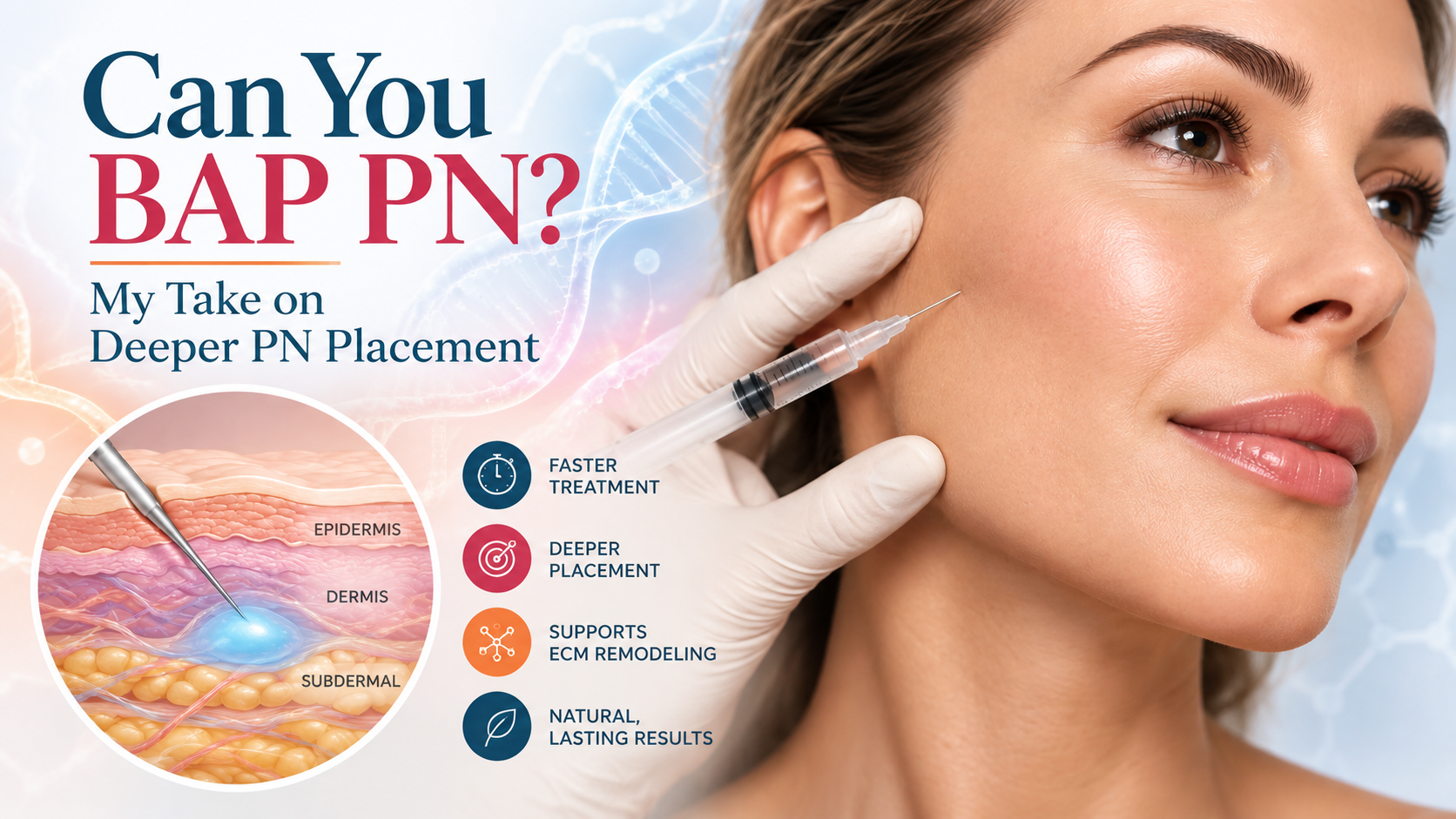
“Can I BAP PN?”
The standard answer is usually something along the lines of: PN is meant to be meso’d. And yes, traditional PN treatment usually involves lots of small, relatively superficial intradermal injections across the treatment area. That makes perfect sense when your primary goal is improving skin quality: texture, fine lines, hydration and that lovely PN glow.
But that isn’t the only thing I want from PN.
I’m very interested in PN as an extra-cellular matrix (ECM) remodeling treatment. I want healthier fibroblast activity, better collagen production and, ultimately, better structural scaffolding underneath my skin. PN is made from relatively long DNA-derived polymers and has increasingly been studied specifically for its role in extracellular matrix remodeling.
So for quite some time, I’ve been doing something different.
I BAP My PN
Instead of covering my entire face with dozens of tiny superficial meso blebs, I often place PN using BAP-style points, usually targeting around the deep dermal/subdermal level. See my article All About the BAP Technique for details.
Why? Because I’m trying to put the PN closer to the deeper tissue I want to remodel, while using relatively few injection points. At that depth, I find the product spreads beautifully through my tissue. The initial pressure of the deposit pushes fluid outward, followed by further movement through the surrounding interstitial space.
And frankly, BAP is fast and easy. I can place a larger, deeper bleb with just a handful of injection points instead of covering my face with dozens of individual meso injections. These blebs usually go down within a few hours for me.
But there is an important distinction here: The bleb disappearing does not necessarily mean every PN molecule traveled everywhere that the fluid did.
PN molecules are large. The fluid carrying them can move relatively easily through the spaces in our tissue, while the PN itself may not travel nearly as far. And I’m okay with that.
I Don’t Need Every PN Molecule to Spread Everywhere
I’m not claiming that BAP distributes PN evenly across the face like HA. It almost certainly doesn’t.
My philosophy is that I don’t need every PN molecule to spread evenly throughout the whole area because the tissue response extends beyond the exact location where the PN ended up. The cells responding to PN participate in a much larger remodeling environment involving fibroblasts, collagen production, inflammatory signaling and ECM turnover.
There is also some interesting new research supporting the broader idea of placing PN deeper. A 2026 prospective split-face study compared traditional intradermal PN with subdermal PN. Both improved skin quality, and subdermal treatment was non-inferior to intradermal treatment for fine-line improvement. Another randomized split-face study compared intradermal needle injections with subdermal PN distributed by cannula and again found comparable improvement between the two techniques. Links to both studies are below.
Neither study proves that my BAP method works the way I think it does. They weren’t studying BAP, they were using a cannula. But I can also see from my own results that BAP placement is working for me. The research simply provides confidence in the underlying idea that PN doesn’t somehow need to live in superficial meso blebs to do its job.
And that brings me to a question I’ve recently started asking.
What If Successful Remodeling Eventually Changes the Equation?
This part is my working theory, not something established by clinical research.
I’ve been actively remodeling my ECM for quite some time. PN hasn’t been working alone. I’ve also used treatments such as microneedling, hADM, human exosomes, and other regenerative approaches intended to improve collagen and ECM structure.
So the tissue I’m putting PN into today is likely quite different from the tissue I was putting it into when I first started. An aging ECM has fragmented collagen and declining structural integrity. After repeated successful remodeling, I believe I have more collagen and a healthier, better-developed ECM.
That’s exactly what I wanted. But could that also change how easily PN moves through it?
Think about pushing a cannula through tissue. People who have undergone a lot of collagen-building and remodeling treatments often describe greater resistance as the cannula passes through certain tissue planes. A denser network of collagen and ECM creates more mechanical resistance.
That makes me wonder: Could the same thing happen to PN when I’m relying on passive tissue dispersion from a handful of BAP points?
The Saline May Spread Better Than the PN
This is where it gets especially interesting to me. My BAP blebs still disappear very quickly. I can watch the fluid disperse, so clearly my tissue is not preventing fluid movement.
But PN is not saline. The large PN molecules have to navigate the physical structure of the ECM. It’s entirely possible that the fluid component can continue moving easily while some of the much larger PN molecules encounter more resistance and remain closer to where I deposited them.
That gives me a possible progression:
Earlier in my regenerative journey:
Less-developed aging ECM → BAP deposit → relatively easy PN dispersion → larger treatment territory.
After substantial ECM remodeling:
Better-developed, denser ECM → BAP deposit → fluid still disperses easily → large PN molecules potentially travel less freely → smaller treatment territory.
Do I know this is happening? Absolutely not. But it makes logical sense to me.
There is also an obvious second phenomena: diminishing returns.
If my ECM is already significantly healthier than it was when I started, there simply isn’t as much low-hanging fruit left to improve. The exact same treatment could still be working perfectly well while producing a much less dramatic visible change.
Most likely, if I am seeing diminishing returns, several things could be happening at once.
Maybe Success Should Eventually Change the Treatment
This is the part I’m thinking about most. If the entire purpose of regenerative aesthetics is to actually change the tissue, why would we assume that the ideal treatment for that tissue should remain exactly the same forever?
Early in the process, BAP with a handful of deeper PN deposits with passive spread is perfectly adequate.
Later, after significant ECM remodeling, perhaps it makes more sense to use more distributed deeper injections so that I am physically placing PN across more of the treatment area instead of relying as heavily on fewer blebs to spread. Perhaps ten points per side instead of the typical five.
Or perhaps subdermal cannula delivery eventually makes sense, mechanically distributing PN throughout the plane. We now have clinical evidence that subdermal PN can work very well, although that research does not tell us that people with heavily remodeled ECM specifically need a cannula. But it would be a great way to spread it.
Or maybe I don’t need to change anything at all. That’s the question I’m exploring.
From Building to Maintaining
I think there is an even bigger lesson here for regenerative aesthetics: At some point, the goal should change.
When we start with aging tissue, we’re trying to rebuild: stimulate fibroblasts, improve collagen, restore ECM quality and repair some of the structural deterioration that accumulated over decades.
But eventually, we need to maintain what we’ve built. The structure is healthy and we want to keep it at peak performance.
Aging doesn’t stop because we improved the ECM. Collagen turnover continues, fibroblasts continue aging and the processes that contributed to ECM degradation are still happening. PN therefore becomes interesting to me not simply as another treatment that makes my skin look better next month, but as something I may periodically use to keep supporting that regenerative environment. Research increasingly supports PN’s relationship with fibroblast activity, collagen synthesis and ECM restoration.
And my maintenance strategy may not ultimately look exactly like my rebuilding strategy. That is something I’m going to be thinking about much more as I work through my larger Cellular Rejuvenation Plan.
For now? Yes, I still BAP PN.
I like what it has done for me, I think there is a sound rationale behind why I use it this way, and emerging research supports the deeper placement I have been using as part of my ECM-building strategy.
Further Reading
Efficacy and Safety of Intradermal Versus Subdermal Injection of Polynucleotide for Facial Improvement: A Prospective Split-Face Study (2026)
https://onlinelibrary.wiley.com/doi/full/10.1111/jocd.71108
Polynucleotide Injection for Enlarged Pores: Comparison of Intradermal Needle and Subdermal Cannula Techniques in a Randomized Split-Face Trial (2026)
https://onlinelibrary.wiley.com/doi/full/10.1111/jocd.70946
From Polydeoxyribonucleotides (PDRNs) to Polynucleotides (PNs): Bridging the Gap Between Scientific Definitions, Molecular Insights, and Clinical Applications of Multifunctional Biomolecules (2025)
https://pmc.ncbi.nlm.nih.gov/articles/PMC11764130
Investigation of Macromolecular Transport Through Tunable Collagen Hyaluronic Acid Matrices (2023)
https://www.sciencedirect.com/science/article/pii/S0927776523000012
Polynucleotides Enhance Collagen Synthesis via Modulating Phosphoenolpyruvate Carboxykinase 1 in Senescent Macrophages: Experimental Evidence (2025)
https://pmc.ncbi.nlm.nih.gov/articles/PMC12429772
Related Articles:
All About the BAP Technique: Pattern and Products
How to actually use the BAP technique
A Cheat Sheet for PN Boosters: Getting Value in Regeneration
How to pick a PN product. I personally prefer Youthfill PN.
RegenaGlow Exo BAP
How I modify my PN BAP by adding human exosomes