
Treatment Type: BAP Technique
Human-based exosomes are routinely injected in South Korea for advanced skin rejuvenation and rapid tissue repair. Far from being experimental, these biological messengers are utilized to coordinate cellular signaling, effectively “re-teaching” the skin how to renew its own collagen and elastin levels. By delivering high-purity vesicles directly into the reticular dermis (2-4mm), this treatment addresses the root causes of aging to restore a luminous, resilient glow that topical serums, and even most other skin boosters, simply cannot achieve on their own.
For this recipe, RegenaGlow Exo BAP combines high-purity human-derived exosomes with non-crosslinked hyaluronic acid to deliver deep dermal regeneration and long-lasting hydration. Applied using the Bio-Aesthetic Point (BAP) method, this formula rejuvenates cellular signaling, supports collagen renewal, and restores the smooth, luminous appearance of balanced, well-hydrated skin.
Important Note: Injecting exosomes has risks that may result in granulomas, nodules, or allergic reactions. This recipe attempts to minimize the risks by ensuring we are mixing appropriate products that will easily and quickly diffuse throughout the mid-dermis. Please familiarize yourself with the risks before attempting this recipe.
Why It Works
Exosomes function as biological messengers that coordinate cell-to-cell repair and regeneration, stimulating fibroblasts and calming post-inflammatory stress. When paired with hyaluronic acid, which binds moisture and improves tissue diffusion, the exosomes can distribute more evenly through the dermal network. Delivered by the BAP technique, the blend reaches the high-vascular zones that maximize diffusion without over-traumatizing the skin, resulting in uniform glow and elasticity improvement.
While many skin boosters provide a temporary surface “glow,” the RegenaGlow Exo BAP protocol is designed for long-term structural remodeling. By targeting the mid-to-deep dermis (3-4mm), we are moving beyond simple hydration and into the realm of bioremodeling.
1. Reaching the “Fiber Factory” (Reticular Dermis)
The skin is divided into the papillary (upper) and reticular (lower) dermis. While the upper layer handles immediate radiance, the reticular dermis — located roughly 2mm to 4mm deep — is where the heavy-duty structural proteins live. By injecting at a 3-4mm depth, you place the exosomes directly among the thickest bundles of collagen and the primary population of fibroblasts responsible for the skin’s structural integrity.
2. Remodeling the ECM “Scaffold”
The Extracellular Matrix (ECM) is the biological scaffold that keeps skin firm. As we age, this scaffold becomes disorganized and fragmented.
- Exosomes act as the “site foremen,” sending signals to clear out old, damaged collagen and instructing cells to lay down fresh, organized fibers.
- Deep Placement ensures these regenerative signals reach the foundation. Superficial treatments often leave deeper laxity unaddressed; deep placement treats the root cause of sagging and thinning.
3. Synergistic Diffusion
Using the BAP (Bio-Aesthetic Points) or Gouri/Iniblanc techniques at this specific depth allows the solution to spread along the natural planes of the deep dermis. This creates a “blanket” of regenerative signaling across the face’s structural layer, rather than leaving isolated deposits near the surface.
4. The Power of the “Base” Carrier
The choice of a carrier — like Hyaron or PN boosters — is critical for structural work:
- Hyaluronic Acid provides the immediate hydration needed to “unstick” the ECM, allowing exosomes to travel and signal more effectively.
- Polynucleotides (PN) provide the raw “building blocks” that fibroblasts require once the exosomes trigger the renewal process.
By combining the all three elements, you are hitting every regenerative pathway:
- Exosomes (Signaling): The “Foremen” that tell the cells to wake up.
- PN/Polynucleotides (Repair): The “Building Blocks” that provide DNA fragments for cell repair.
- HA (Environment): The “Infrastructure” that provides the hydration and space for the other two to move and work.
In the current landscape of DIY and professional regenerative aesthetics, a Human Exosome + PN/HA BAP treatment sits at the very top of the “power” scale. Most traditional treatments are passive. Dermal fillers add volume, and standard HA boosters add moisture. They don’t necessarily “talk” to your cells. Exosomes are active signaling molecules. They carry a cargo of proteins, mRNA, and growth factors that essentially reboot the skin’s local environment. You aren’t just filling a hole; you are changing the biological age of the tissue.
While Polynucleotides (PN) on their own are incredible for healing, and Toxins (Botox) are great for surface smoothing, neither has the same “total tissue overhaul” potential that human-derived exosomes offer. Currently, short of full-blown surgical intervention or high-energy professional laser resurfacing, this is arguably the most advanced “biological” approach available.
Choosing An Exosome Base
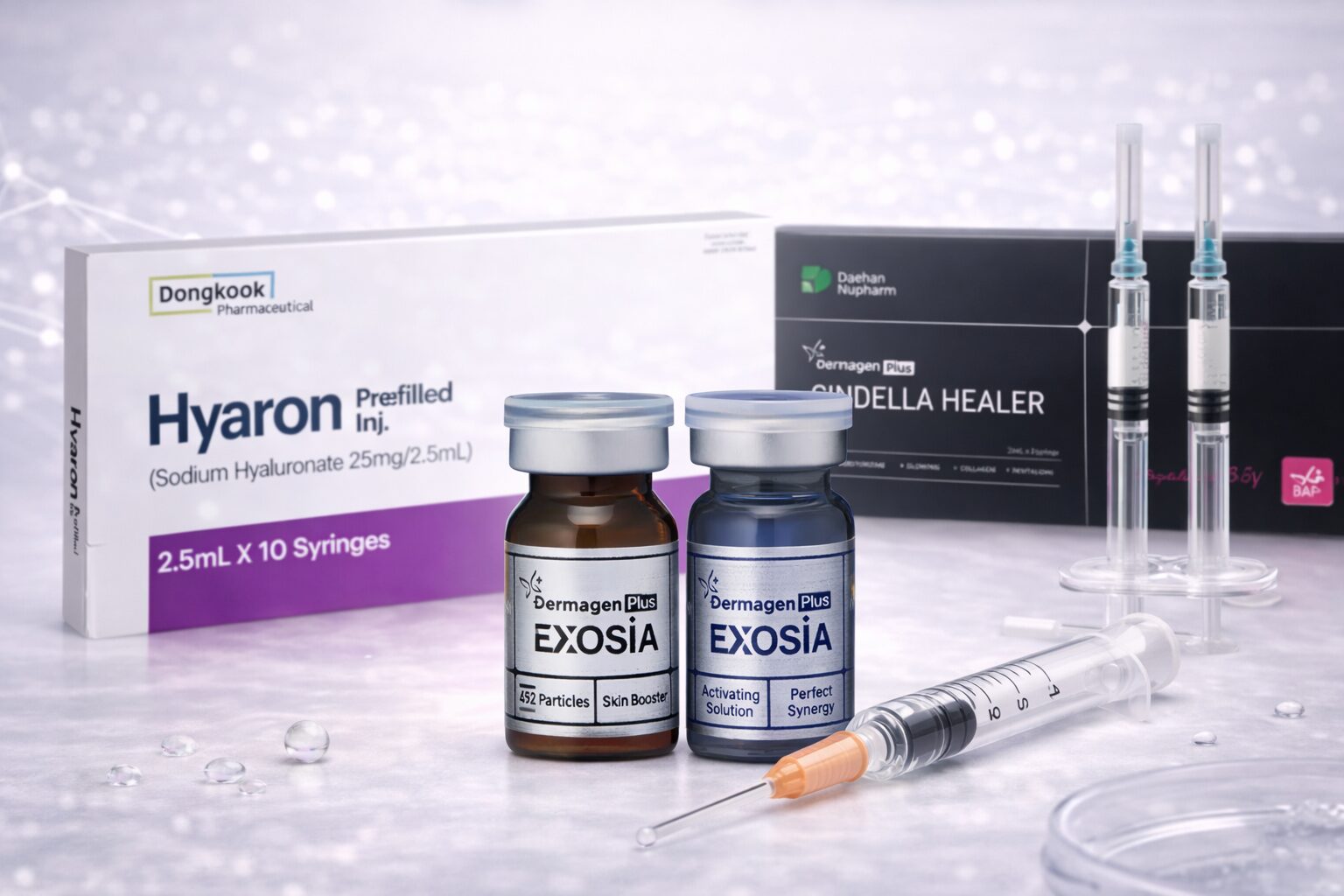
The most effective formulations for this blend are Dermagen EXOSIA and Filcore ExoHealer P198, both of which contain human umbilical-cord-derived exosomes from Cell Bio Science’s USC1994-CMT platform. Both brands provide ultra-purified, high-count vesicles suitable for mixing with sterile HA carriers. Do NOT use any plant-based exosome or anything pre-mixed with other ingredients; I strongly urge you to only use the products I mentioned.
Only the lyophilized exosome vial is required for this recipe; omit the activator solution.
Choosing a Base
The carrier used to reconstitute exosomes determines how evenly the particles diffuse through the dermis and how the skin feels afterward. A thin, non-crosslinked hyaluronic acid (HA) or PN/PDRN booster provides the ideal texture for even diffusion, stable suspension, and deep hydration without damaging exosomes during mixing.
Best Choices:
- HA Only: Hyaron – classic non-crosslinked HA (10 mg/mL); highly stable, sterile, and perfectly suited for exosome blending.
- PN: Dermagen Cindella Healer, Oasis Repair, AMI X Plus – Pure PN has strong regenerative potential. Choose one with no additives to help prevent irritation or issues.
- PDRN: Kiara Reju, Lusciderm PDRN+ – PDRN for healing. Choose one with no additives to help prevent irritation or issues.
All of these are sold in syringe format with a volume between 2.0-2.5mL. The ideal base should resemble a watery serum—thin enough to pass easily through a 32 G × 4 mm needle, yet cohesive enough to hold the exosome suspension evenly within the dermis.
This is important: It needs to be a sterile product intended for injection. It also needs to be a simple formula to minimize the potential for the body to reject it, treat it as foreign bodies, and create granulomas. Resist the urge to add too many ingredients or anything that will not diffuse easily.
Mixing Ratio and Preparation
- Reconstitute one vial of lyophilized exosomes directly with the base instead of saline or activator. This forms the base regenerative solution.
- (Optional) Add 2 mL of a PDRN sterile solution such as Revitalex or New-DN for additional healing and anti-inflammatory support.
The exosome vial is large enough to hold up to 5mL of liquid, so both the Base and PDRN should fit. - Gently swirl the vial until the powder is completely dissolved. Avoid vigorous shaking; exosomes are delicate and shear-sensitive.
Note: You may notice that you have less solution than you started with. I don’t pretend to understand how this works, but it seems common to “lose” liquid volume when reconstituting exosomes (something about non-Newtonian gels with sticky, high-surface-tension fluids that cling to every contact point). If this happens, you can either add additional saline, HA, or Revitalex to make up for it, or simply adjust down the amount you place in each BAP point. You are aiming for a total of 2.0-2.5mL for each area (face or neck). - Once fully mixed, draw the solution back into the original Base syringe.
- Attach a 30G × 4mm or similar injection needle. Alternatively, you can use a 13mm length needle if you need to twist for better angles.
- If PDRN was added and the total volume exceeds one syringe, either:
- Divide the solution evenly into two sterile syringes (one for each area), or
- Draw up half the mixture for the face, then reload the remaining half for the neck, always changing the needle tip between zones.
The finished blend should appear clear to slightly opalescent, smooth, and fluid—easy to express without pressure but cohesive enough to stay within the dermal layer during injection.
Most exosome vials are designed to be reconstituted with approximately 5 mL of saline for standard clinical use. When reconstituted instead with a 2–2.5 mL HA Base, the result is a more concentrated, double-strength solution. This higher exosome density is still fully safe; it enhances regenerative signaling and visible radiance but also makes the formula slightly richer in texture. Because the viscosity remains low, it still flows easily through a 32 G × 4 mm needle and diffuses evenly with the BAP technique. If 2 mL of Revitalex PDRN (or a similar thin PDRN solution) is added to the mix, the total volume returns to roughly standard clinical strength, maintaining normal exosome concentration while adding extra healing and anti-inflammatory benefits.
Application Guidelines
Technique: BAP (Bio-Aesthetic Point) method
Depth: Generally 2–2.5 mm within the upper-to-mid dermis; may extend slightly deeper (up to ≈ 4 mm) in thicker areas such as the cheeks and jawline, where dermal tissue is denser. Avoid deep placement near the temples, chin, or perioral region, where the skin is thinner and vascular structures are more superficial.
In the neck, the skin is flexible and mobile, so use the pinch technique to gently lift the tissue away from underlying structures before injecting. Keep the angle shallow and the pressure light—just enough to create a smooth, low bleb that settles flat within a few minutes.
Volume: 0.2 – 0.25 mL per point (10 points per area)
Areas: Face and/or neck
Check my BAP guide here for the face and neck mapping.
(Optional) After completing the BAP injections, a vial of EXOSIA or P198 Activator Solution can be microneedled over the top for an all-over luminosity boost. I do this every time, it’s a perfect complement to the treatment!
- Spread a thin layer across the treated zones, then microneedle lightly at 0.25–0.75 mm using a fresh cartridge or separate device. This shallow pass helps the exosomes and hyaluronic acid diffuse uniformly across the epidermal and superficial dermal layers, promoting even hydration and radiance.
- Because the BAP deposits sit deeper in the upper-to-mid dermis (2–2.5 mm), this light surface microneedling does not disturb or “pull through” the deeper injections. Instead, it works above them, sealing the treatment with a smoothing, glass-skin finish while leaving the regenerative layer intact.
- Move gently and avoid excessive overlap—this step is meant for surface integration, not further collagen induction. If the skin already appears plump and hydrated from the BAP phase, this enhancement can be skipped.
Tips and Timing
- Take an allergy med or antihistimine beforehand. This helps the body not over-respond.
- Use the mixture within a few hours – exosomes degrade rapidly once hydrated.
- Avoid adding acids or other bioactive ingredients; exosomes are pH-sensitive and fragile.
- Typically performed once per month or after energy-based procedures ( laser, BBL, RF ) to accelerate healing and restore radiance.
Adapting RegenaGlow Exo for Iniblanc/Gouri Technique
RegenaGlow Exo can also be delivered using the Iniblanc or Gouri method – they are the same thing. It’s a deep-dermal (≈3.0–3.5 mm) five-point technique that similar to the BAP pattern but targets firmer tissue remodeling rather than hydration. Each deposit (≈0.2–0.25 mL) is placed slightly deeper and more posterior, supporting collagen and elasticity. Because the formula is thin and non-crosslinked, it diffuses smoothly at this level without clumping or surface irregularity.
Unlike the traditional BAP technique, which intentionally avoids the forehead and perioral zones to minimize vascular risk when using HA-rich products, the Inblanc/Gouri method expands coverage to include the forehead, temples, and lateral cheek zones. This allows RegenaGlow Exo to reach more photodamaged and metabolically active areas—precisely where exosomes deliver the most visible rejuvenation. Because RegenaGlow Exo is a non-filler, low-viscosity biological solution, it carries none of the embolic or nodular risk associated with dense HA gels. That makes it safe for the forehead plane, where skin is thinner and diffusion pathways are tighter.
The result is more even regeneration and glow across the full face, including the high-light zones that catch reflection (forehead, temples, upper cheeks).
Further Reading
- The BAP technique – Face EN (PROFHILO®) (PDF) — direct protocol overview
- The 10-point BAP technique for bio-remodelling on the neck (PDF) — neck-specific BAP injection map
- Exploring the BAP Technique — blog article explaining BAP
- Profhilo BAP Technique – What Is It? – blog article explaining BAP using Profhilo
- Gouri Training (UK) – Shows the Iniblac/Gouri technique
This formulation is shared for educational / research purposes. Not intended for diagnosis, treatment, or substitution for professional medical care. Always follow sterile technique and local regulations.