
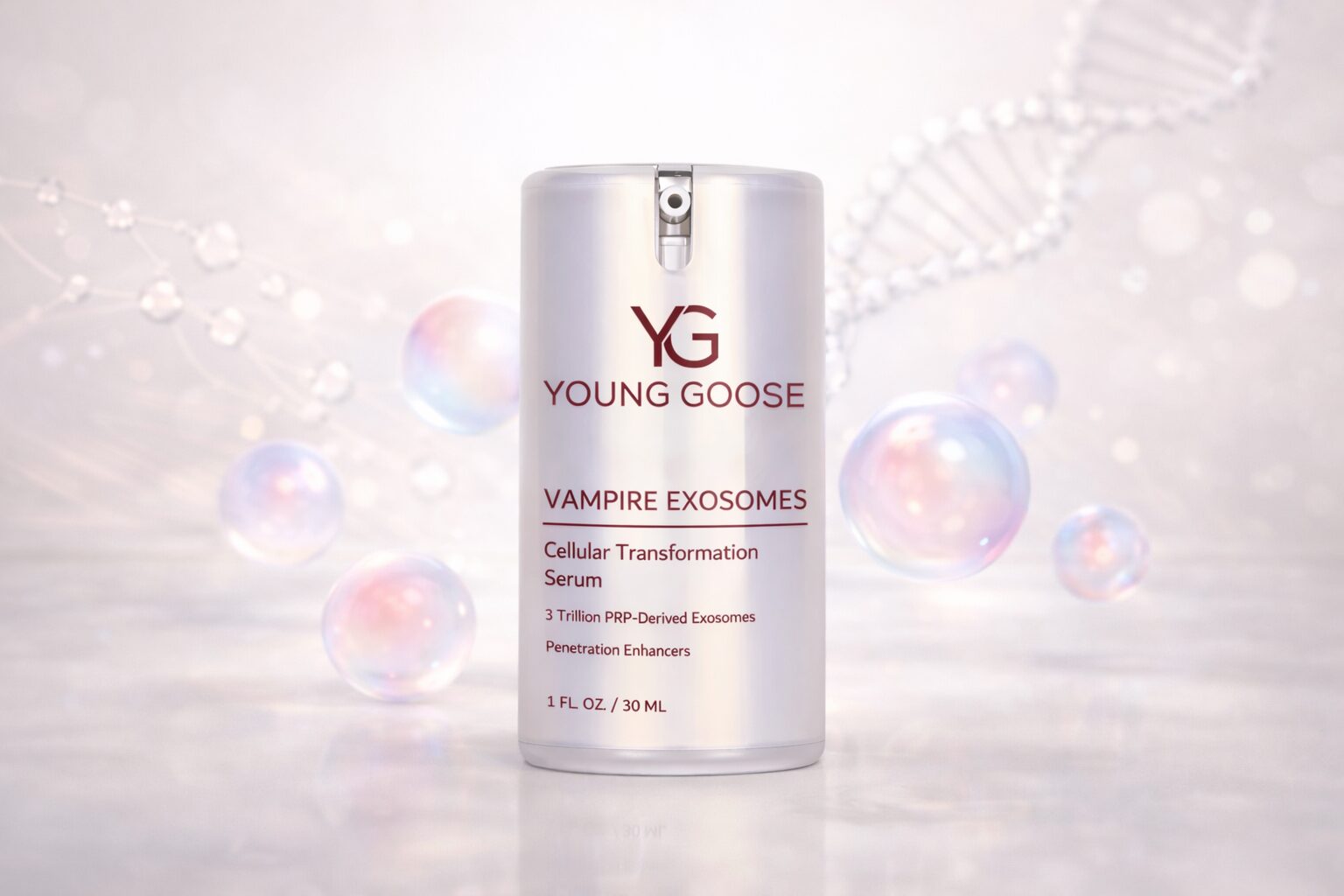
I have been deep-diving exosome and growth factor-based serums and there are so many caution flags. Most brands use vague marketing language that oversimplifies the science while catering to consumers who want something that sounds advanced. Meanwhile, they hide their true formulas from both competitors and anyone willing to look deeper. Clinical data and lab tests are often limited or unpublished. Exosome viability is unverified, and reported counts rarely follow standardized metrics.
Among the new wave of regenerative skincare one product stands apart: Vampire Exosomes by Young Goose.
It’s a platelet-derived, quantifiable, medically inspired formulation designed to deliver the body’s own wound-healing messages directly to the skin while staying within cosmetic regulatory boundaries.
What follows is what makes it unique, how it differs from competitors Calecim Professional Serum and Elevai Enfinity, and the additional biological effects that science recognizes but the FDA forbids brands to claim.
Exceptionally High Concentration of Platelet-Derived Exosomes
Vampire claims over 3 trillion exosomes per 30 mL, several times higher than typical exosome serums. These are quantified extracellular vesicles rather than estimated or unverified counts.
Why it matters: Exosomes are the actual carriers of regenerative signals: proteins, lipids, and microRNAs that instruct cells to repair tissue, reduce inflammation, and synthesize collagen and elastin. The biological effect depends not only on the quality of those vesicles but also on their quantity. A dense, standardized concentration increases the probability that enough intact exosomes reach skin cells to trigger visible remodeling, especially after procedures that create open microchannels such as microneedling or laser resurfacing.
Versus others:
- Calecim uses cord-derived stem-cell media with an unspecified number of exosomes and no particle quantification.
- Elevai references a “billion exosomes” range but provides no third-party verification.
Vampire is currently the only product with verified multi-trillion counts, giving it a measurable potency advantage.
Platelet-Derived (PRP) Source Instead of Stem Cell, Fat, or Plant
Most commercial exosome serums use mesenchymal stem cell (MSC), umbilical, or even plant-derived vesicles. Vampire Exosomes uses platelet-derived exosomes (PRP-EXO): vesicles isolated from human platelets, the same cells responsible for initiating the wound-healing cascade in the body.
Why it matters: Platelets naturally release exosomes rich in wound-repair signals, growth factors, and specific microRNAs that coordinate tissue regeneration. This makes them biologically closer to the processes involved in skin recovery and matrix rebuilding. In theory, platelet-derived exosomes deliver a more targeted “repair message” than stem-cell or plant-derived alternatives, which may focus more on angiogenesis or general immunomodulation rather than skin-specific regeneration.
Versus others:
- Calecim: Umbilical-derived; optimized for stem-cell proliferation, not wound repair.
- Elevai: Also umbilical-MSC based; strong for anti-inflammatory modulation but less targeted to epidermal injury.
Vampire’s platelet exosomes directly replicate the body’s injury-repair message, making them uniquely suited for post-microneedling or laser regeneration.
Verified Quantification and microRNA Profiling
Each batch is said to undergo third-party testing that confirms the number of exosomes and analyzes their microRNA composition, a unique level of transparency in the cosmetic field.
Why it matters: MicroRNAs are short genetic regulators that fine-tune cellular behavior for turning on collagen synthesis genes, suppressing inflammatory cascades, or clearing senescent (“zombie”) cells. Knowing which microRNAs dominate in a formulation provides insight into its biological intent. Third-party quantification also helps verify that the serum delivers consistent potency from batch to batch, addressing a major criticism of the exosome skincare industry where few products disclose actual counts or molecular profiles.
Versus others:
- Calecim and Elevai publish no miRNA profiles; their compositions shift with donor variability.
Vampire is the first exosome cosmetic to disclose molecular signatures, a scientific transparency benchmark in the category.
To further reinforce that transparency, Young Goose has announced plans to include a unique QR code on each bottle linking directly to the third-party lab report for that batch. Scanning the code will allow consumers to view the verified exosome count, size distribution, and microRNA composition, effectively merging medical-style traceability with consumer skincare. This level of batch-level disclosure is unprecedented in the category and underscores the brand’s commitment to scientific accountability rather than marketing claims.
Synergistic Energy Support Through RejuvNAD™
Beyond exosomes, the formula includes RejuvNAD™, a sunflower-sprout extract that activates NAMPT, the rate-limiting enzyme in the body’s NAD⁺ salvage pathway. Instead of adding NAD⁺ precursors directly, this mechanism encourages the skin to recycle and elevate its own NAD⁺ levels.
Why it matters: NAD⁺ is essential for DNA repair, cellular energy, and youthful metabolism. Raising NAD⁺ availability improves how efficiently cells can respond to the exosome’s repair instructions. In simple terms, exosomes deliver the “blueprint” for regeneration, while NAD⁺ supplies the “energy budget” to execute it. Combining the two addresses both the informational and energetic sides of cellular rejuvenation.
Versus others:
- Calecim and Elevai rely solely on extracellular signaling; no energy-support component.
Vampire is the only exosome serum that also amplifies the cell’s energetic capacity to respond.
Designed as a Post-Procedure and Daily Regenerative Adjunct
The serum is formulated for post-microneedling, laser, or peel recovery, but also mild enough for daily application. Its purpose is to extend the regenerative window opened by professional treatments and maintain the results between sessions.
Why it matters: Microneedling and lasers work by triggering controlled injury and a subsequent healing cascade. Applying exosomes immediately afterward amplifies that process by flooding the skin with messenger vesicles identical to those released by the body during repair. Using them daily afterward continues to nudge the skin toward a pro-healing, pro-collagen environment instead of letting inflammation dominate. This bridges the gap between clinic-level interventions and home maintenance.
Versus others:
- Calecim is used post-procedure but lacks daily-use resilience; it can be occlusive or sticky.
- Elevai is designed for daily use but less concentrated and slower acting.
Vampire uniquely merges clinic-level potency with home-use stability, offering continuity between professional treatment and everyday recovery.
Stability and Compatibility of the Vehicle
Exosomes are fragile lipid vesicles that can be destroyed by acidic pH, surfactants, or incompatible actives such as L-ascorbic acid. Vampire Exosomes uses a neutral-pH, barrier-supporting base containing glycol penetration enhancers, panthenol (vitamin B5), and beta-glucan, ingredients that hydrate while maintaining exosome integrity.
Why it matters: Many exosome products lose potency once mixed with harsh ingredients or unstable formulations. Preserving vesicle structure ensures that the microRNAs and proteins remain protected until they contact skin cells. A stable, compatible medium also allows the serum to work synergistically with professional treatments without irritating the barrier or denaturing the exosomes before they can function.
Versus others:
- Calecim uses a growth-media gel that can oxidize and is pH-sensitive but unverified for vesicle stability.
- Elevai contains peptides and antioxidants that may partially destabilize vesicles over time.
Vampire is engineered for exosome preservation first, ensuring viable delivery rather than theoretical inclusion.
The Likely Origin: Korea’s Exosome Research Powerhouse
While Young Goose notes that Vampire is “proudly made in the USA,” the company has also stated in interviews that its exosome material is sourced from a Korean biotech partner, consistent with the country’s leadership in exosome manufacturing and quality control. In the skincare industry, “Made in the USA” typically refers to the final formulation, bottling, and regulatory oversight, not necessarily the origin of the biological raw material.
Although Young Goose has not disclosed its manufacturing partner, the advanced platelet-derived exosome platform and third-party verification model strongly suggest collaboration with a leading Korean biotech: possibly CHA Biotech or one of its affiliated GMP exosome facilities. This is an educated guess, however, there are no other options that are a better fit.
CHA Biotech is one of Asia’s most respected regenerative-medicine groups, encompassing CHA University, CHA Bio Complex, and multiple GMP-certified exosome and stem-cell manufacturing plants in Pangyo and Bundang. The company has published dozens of peer-reviewed studies on platelet- and stem-cell-derived exosomes, wound healing, scar reduction, and anti-senescence signaling, and its technology underpins several FDA-registered investigational exosome therapeutics.
Its facilities specialize in Nanoparticle Tracking Analysis (NTA), Next-Generation Sequencing (NGS), and microRNA cargo profiling, the exact analytical tools that Young Goose cites in its own transparency claims.
If Vampire is indeed connected to CHA’s platform, it would explain the serum’s unusually high level of data verification, biological purity, and clinical rigor, traits rarely seen in cosmetic formulations.
Why It Ranks Highest Among Exosome Serums
Vampire distinguishes itself through its platelet origin, high verified vesicle count, microRNA profiling, NAD⁺-supportive co-actives, professional-grade use model, and formulation stability. Together these elements aim to make it a reproducible, biologically active, and procedure-compatible exosome system rather than another generic “exosome-infused” cosmetic.
When compared across concentration, source authenticity, analytical transparency, metabolic synergy, and formulation integrity, Vampire integrates all five pillars of regenerative skincare into one system.
- It delivers the highest verified vesicle density.
- It uses platelet-specific repair signals, biologically closer to human wound healing than stem or plant exosomes.
- It provides third-party-verified molecular data, bridging consumer skincare with laboratory rigor.
- It incorporates NAD⁺-supporting technology to power those signals.
- It functions as both a clinical-grade recovery tool and a daily longevity serum.
- It preserves vesicle integrity with a biocompatible, stable vehicle.
Together, these features position Vampire as the most advanced, data-driven exosome formulation currently available, surpassing Calecim and Elevai in concentration, biological relevance, transparency, and performance potential. More extensive independent trials, along with anecdotal customer reviews, are needed to prove these advantages.
A True Medical Grade Serum
U.S. FDA regulations limit cosmetics to “appearance” claims.
However, there are multiple medical-grade biological effects that platelet-derived exosomes could plausibly exert based on published exosome research, but that Young Goose (YG) cannot legally claim of Vampire Exosomes. Let’s look at what science says.
True Tissue Regeneration and Wound Healing
Platelet exosomes are documented to:
- Stimulate fibroblast proliferation and migration
- Up-regulate collagen types I and III, elastin, and hyaluronic acid synthase
- Accelerate re-epithelialization and angiogenesis after injury
Why YG can’t say it:
- Those effects constitute healing and tissue regeneration, which are medical functions.
- Thus, they must phrase it as “improving the look of texture or elasticity” instead of “repairing tissue damage” or “accelerating wound healing.”
Anti-Inflammatory Cytokine Modulation
Exosomes from platelets and MSCs can down-regulate pro-inflammatory cytokines (TNF-α, IL-1β, IL-6) and up-regulate IL-10. This has been observed in models of dermatitis, psoriasis, and post-injury inflammation.
Why YG can’t say it:
- “Reducing inflammation” implies treatment of an inflammatory condition – a drug claim.
- They can only say “soothes the appearance of redness” or “visibly calms stressed skin.”
Clearance of Senescent (“Zombie”) Cells
Certain platelet- and stem-cell-derived exosomes carry microRNAs (e.g., miR-34a, miR-146a) that promote apoptosis of senescent cells or suppress the SASP inflammatory network (IL-6, MMPs).
That’s genuine cellular rejuvenation and anti-senescence therapy.
Why YG can’t say it:
- Eliminating senescent cells is altering a biological population, a hallmark of drug/biologic activity.
- They must reframe it as “reduces visible signs of aging” or “supports youthful skin behavior.”
Gene-Level or Epigenetic Reprogramming
Exosomal microRNAs and long non-coding RNAs can modulate gene expression of collagen synthesis, antioxidant enzymes, and DNA repair factors.
This is measurable reprogramming of the skin’s transcriptome.
Why YG can’t say it:
- Any reference to “gene repair,” “DNA modification,” or “epigenetic changes” is squarely therapeutic.
- The cosmetic version is “encourages skin’s natural renewal processes.”
Angiogenesis and Microcirculatory Support
Platelet exosomes release VEGF, PDGF, and FGF-2, which promote new capillary growth and oxygenation in damaged tissue.
Why YG can’t say it:
- Stimulating angiogenesis = creating new blood vessels = medical therapy.
- They must phrase it as “improves skin vitality and radiance” rather than “enhances microvascular repair.”
Immunomodulation and Autoimmune Balance
Platelet exosomes can normalize immune signaling, reducing overactive immune responses and supporting macrophage polarization (M1→M2).
Why YG can’t say it:
- That’s immune modulation regulated as biologic therapy.
- They are restricted to cosmetic phrasing like “helps skin appear balanced and resilient.”
Structural Integration Into the Extracellular Matrix
Electron microscopy and proteomic data show that exosomes can fuse with dermal fibroblasts, transfer active proteins and RNAs, and integrate into the extracellular matrix (ECM) to orchestrate long-term remodeling.
Why YG can’t say it:
- Integrating into tissue or altering ECM architecture implies anatomical modification. Again, a drug claim.
- They can only reference “improved firmness and elasticity.”
Neuro-Inflammatory and Skin-Brain Axis Modulation
Emerging platelet-exosome research shows down-regulation of cortisol-linked inflammatory pathways and potential influence on neuropeptide signaling in the skin–brain axis.
Why YG can’t say it:
- That crosses into systemic effect territory. The FDA would treat this as a drug or biologic acting beyond the skin.
- They instead say “supports calm, balanced skin” or “reduces visible stress on skin.”
In Short
Medical capabilities (scientifically plausible):
- Induce fibroblast proliferation and collagen/elastin synthesis
- Accelerate wound closure and angiogenesis
- Clear senescent cells and reduce SASP cytokines
- Modulate gene and immune expression
- Enhance cellular NAD-dependent repair
Cosmetic-legal phrasing (what YG can safely claim):
- Improves the appearance of texture, tone, and firmness
- Reduces visible redness and fatigue
- Promotes smoother, more radiant skin
- Supports skin’s natural rejuvenation process
The real power of platelet-derived exosomes likely lies in true regenerative and anti-senescent mechanisms backed by medical literature.
Because those mechanisms inherently change cellular behavior, they fall under the FDA’s definition of a biologic therapy, not a cosmetic.
Thus, Vampire Exosomes must limit itself to surface-appearance language – even though, biologically, it operates much deeper.
The Bigger Picture
Vampire Exosomes occupies the rare intersection where medical-grade regenerative biology meets cosmetic accessibility.
Its visible effects – smoother texture, even tone, improved firmness, faster post-procedure recovery – are the surface reflection of deeper cellular programs: fibroblast activation, senescence reversal, angiogenesis, and immune modulation.
Those deeper actions are precisely what the brand cannot describe outright – yet they form the scientific foundation that makes the serum distinct from anything else in the cosmetic exosome category.
Should We Be Skeptical?
While skepticism around emerging cosmetic technologies is valuable for consumer protection, it’s often voiced by those outside the laboratory rather than by hands-on researchers and clinicians advancing the science. In my view, the regulatory caution is understandable, but it sometimes stifles necessary innovation. True progress is driven by innovators willing to explore new therapies, test novel ideas, and embrace responsible risk-taking, frequently paving the way for advancements later recognized by even the most cautious critics. Balancing careful scrutiny with an open-minded approach allows promising breakthroughs like platelet-derived exosomes to reach their full potential and redefine what’s possible in aesthetic medicine.
In Summary
- Highest verified exosome density on the market
- Platelet-specific repair signaling aligned with human wound healing
- Third-party microRNA and potency data ensuring reproducibility
- NAD⁺-enhancing cofactor system for metabolic support
- Dual-use design for procedures and daily longevity
- Vesicle-safe formulation preserving biological integrity
And beneath the permitted claims lies a range of medically validated cellular effects – regeneration, anti-inflammatory signaling, senescence clearance, and epigenetic renewal – that current regulations prevent from being stated but modern science strongly supports.
Vampire Exosomes is therefore not just a skincare serum; it’s a standardized, biologically active repair system built on authentic medical exosome technology.
Further Reading
Exosome & Growth Factor Skincare: The Ultimate Guide
Are Exosomes Dangerous? What About mRNA?
External Links
Video: Can Vampire Exosomes Really Rebuild Aging Skin? Here’s the Science
Video: Joel Marshall: The Truth About Microneedling, Exosomes & Why RF Isn’t What You Think
This article reflects independent analysis and interpretation based on publicly available information and scientific literature. It is not affiliated with or endorsed by Young Goose or CHA Biotech.